


Page 566 - 9780077418427.pdf
P. 566
/Volume/201/MHDQ233/tat78194_disk1of1/0073378194/tat78194_pagefiles
          tiL12214_ch22_541-564.indd Page 543  9/23/10  11:08 AM user-f465
          tiL12214_ch22_541-564.indd Page 543  9/23/10  11:08 AM user-f465             /Volume/201/MHDQ233/tat78194_disk1of1/0073378194/tat78194_pagefile


                                                                               COMPOSITION OF THE ATMOSPHERE
                                                                               A sample of pure, dry air is colorless and odorless and com-
                                                                               posed mostly of the molecules of just three gases: nitrogen (N 2 ),
                                                                                oxygen  (O 2 ), and argon (Ar). Nitrogen is the most abundant
                                                                               (about 78 percent of the total volume), followed by oxygen (about
                                                                               21 percent), then argon (about 1 percent). The molecules of these
                                                                               three gases are well mixed, and this composition is nearly con-
                                                                               stant everywhere near Earth’s surface (Figure 22.4). Nitrogen
                                                                               does not readily enter into chemical reactions with rocks, so it
                                                                               has accumulated in the atmosphere. Some nitrogen is removed
                                                                               from the atmosphere by certain bacteria in the soil and by light-
                                                                               ning. The compounds that are formed are absorbed by plants and
                                                                               consequently utilized throughout the food chain. Eventually, the
                                                                               nitrogen is returned to the atmosphere through the decay of plant
                                                                               and animal matter. Overall, these processes of nitrogen removal
                                                                               and release must be in balance since the amount of nitrogen in
                                                                               the atmosphere is essentially constant over time.
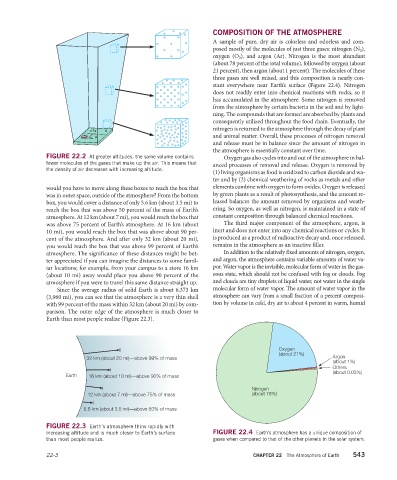
                       FIGURE 22.2  At greater altitudes, the same volume contains   Oxygen gas also cycles into and out of the atmosphere in bal-
                       fewer molecules of the gases that make up the air. This means that   anced processes of removal and release. Oxygen is removed by
                       the density of air decreases with increasing altitude.
                                                                               (1) living organisms as food is oxidized to carbon dioxide and wa-
                                                                               ter and by (2) chemical weathering of rocks as metals and other
                       would you have to move along these boxes to reach the box that   elements combine with oxygen to form oxides. Oxygen is released
                       was in outer space, outside of the atmosphere? From the bottom   by green plants as a result of photosynthesis, and the amount re-
                       box, you would cover a distance of only 5.6 km (about 3.5 mi) to  leased balances the amount removed by organisms and weath-
                       reach the box that was above 50 percent of the mass of Earth’s   ering. So oxygen, as well as nitrogen, is maintained in a state of
                       atmosphere. At 12 km (about 7 mi), you would reach the box that  constant composition through balanced chemical reactions.
                       was above 75 percent of Earth’s atmosphere. At 16 km (about   The third major component of the atmosphere, argon, is
                       10 mi), you would reach the box that was above about 90 per-  inert and does not enter into any chemical reactions or cycles. It
                       cent of the atmosphere. And after only 32 km (about 20 mi),   is produced as a product of radioactive decay and, once released,
                       you would reach the box that was above 99 percent of Earth’s   remains in the atmosphere as an inactive filler.
                       atmosphere. The significance of these distances might be bet-  In addition to the relatively fixed amounts of nitrogen,  oxygen,
                       ter appreciated if you can imagine the distances to some famil-  and argon, the atmosphere contains variable amounts of water va-
                       iar locations; for example, from your campus to a store 16 km   por. Water vapor is the invisible, molecular form of  water in the gas-
                       (about 10 mi) away would place you above 90 percent of the   eous state, which should not be confused with fog or clouds. Fog
                       atmosphere if you were to travel this same distance straight up.  and clouds are tiny droplets of liquid water, not water in the single
                           Since the average radius of solid Earth is about 6,373 km   molecular form of water vapor. The amount of water vapor in the
                       (3,960 mi), you can see that the atmosphere is a very thin shell   atmosphere can vary from a small fraction of a  percent composi-
                       with 99 percent of the mass within 32 km (about 20 mi) by com-  tion by volume in cold, dry air to about 4  percent in warm, humid
                       parison. The outer edge of the atmosphere is much closer to
                       Earth than most people realize (Figure 22.3).


                                                                                                     Oxygen
                                                                                                     (about 21%)
                                     32 km (about 20 mi)—above 99% of mass                                            Argon
                                                                                                                      (about 1%)
                                                                                                                      Others
                              Earth   16 km (about 10 mi)—above 90% of mass                                           (about 0.03%)
                                                                                            Nitrogen
                                     12 km (about 7 mi)—above 75% of mass                   (about 78%)
                                    5.6 km (about 3.5 mi)—above 50% of mass


                        FIGURE 22.3  Earth’s atmosphere thins rapidly with
                       increasing altitude and is much closer to Earth’s surface   FIGURE 22.4  Earth’s atmosphere has a unique composition of
                       than most people realize.                               gases when compared to that of the other planets in the solar system.

                        22-3                                                                CHAPTER 22  The Atmosphere of Earth   543

