


Page 721 - 9780077418427.pdf
P. 721
Volume/207/MHDQ243/tiL12214_disk1of1/0073512214/tiL12214_pagefiles
tiL12214_appe_643-698.indd Page 698 08/12/10 1:01 PM user-f463
tiL12214_appe_643-698.indd Page 698 08/12/10 1:01 PM user-f463 Volume/207/MHDQ243/tiL12214_disk1of1/0073512214/tiL12214_pagefiles
−2
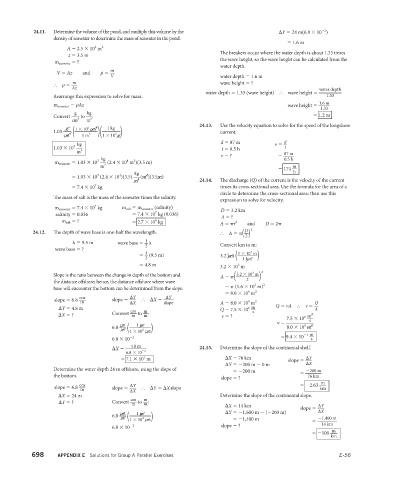
24.11. Determine the volume of the pond, and multiply this volume by the ΔY = 24 m(6.8 × 10 )
density of seawater to determine the mass of seawater in the pond.
= 1.6 m
4
A = 2.5 × 10 m 2
The breakers occur where the water depth is about 1.33 times
z = 3.5 m
the wave height, so the wave height can be calculated from the
m seawater = ?
water depth.
m _
V = Az and ρ =
V water depth = 1.6 m
m _ wave height = ?
∴ ρ =
Az water depth
water depth = 1.33 (wave height) ∴ wave height = _
Rearrange this expression to solve for mass. 1.33
_
1.6 m
m seawater = ρAz wave height =
1.33
kg
g
_ _
Convert to . = 1.2 m
cm 3 m 3
24.13. Use the velocity equation to solve for the speed of the longshore
3 )(
g
3(
6
_ _
_ 1 × 10 cm 3 1 kg 3 )
1.03 current.
cm 1 m 1 × 10 g
d = 87 m d _
kg
3 _ v =
1.03 × 10 t = 0.5 h t
m 3 87 m
v = ? = _
kg
3 _ 4 2 0.5 h
m seawater = 1.03 × 10 (2.4 × 10 m )(3.5 m)
m 3 m _
= 174
h
kg
_
2
4
3
= 1.03 × 10 (2.4 × 10 )(3.5) (m )(3.5m)
m 3 24.14. The discharge (Q) of the current is the velocity of the current
7
= 7.4 × 10 kg times its cross-sectional area. Use the formula for the area of a
circle to determine the cross-sectional area; then use this
The mass of salt is the mass of the seawater times the salinity.
expression to solve for velocity.
7
m seawater = 7.4 × 10 kg m salt = m seawater (salinity) D = 3.2 km
7
salinity = 0.036 = 7.4 × 10 kg (0.036) A = ?
6
m salt = ? = 2.7 × 10 kg A = πr and D = 2π
2
D _
2
24.12. The depth of wave base is one-half the wavelength. ∴ A = π ( )
2
1 _
λ = 9.5 m wave base = λ
2 Convert km to m:
wave base = ? 3
1 _
1 × 10 m
= (9.5 m) 3.2 km ( _ )
2 1 km
= 4.8 m 3.2 × 10 m
3
3
3.2 × 10 m
Slope is the ratio between the change in depth of the bottom and A = π ( _ ) 2
the distance offshore; hence, the distance offshore where wave 2 3 2
base will encounter the bottom can be determined from the slope. = π (1.6 × 10 m)
6
= 8.0 × 10 m 2
ΔY
cm _ _
ΔY
_
slope = 6.8 slope = ∴ ΔX =
6
m ΔX slope A = 8.0 × 10 m 2 _
Q
6 m _
ΔY = 4.8 m _ m _ Q = 7.5 × 10 Q = vA ∴ v =
A
cm
s
ΔX = ? Convert to : v = ? 6 m _ 3
m
m
7.5 × 10
__
s
_ 1 m v = 6 2
cm _
m (
2 )
6.8 1 × 10 cm 8.0 × 10 m
−1 m _
s
6.8 × 10 −2 = 9.4 × 10
_
4.8 m
ΔX = 24.15. Determine the slope of the continental shelf.
6.8 × 10 −2
ΔY
1
= 7.1 × 10 m ΔX = 76 km slope = _
ΔY = −200 m − 0 m ΔX
Determine the water depth 24 m offshore, using the slope of
−200 m
= −200 m = _
the bottom. 76 km
slope = ?
m _
_ _ = −2.63
cm
ΔY
slope = 6.8 slope = ∴ ΔY = ΔX slope km
m ΔX
ΔX = 24 m Determine the slope of the continental slope.
_
m _
cm
ΔY = ? Convert to :
m
m
ΔX = 14 km
ΔY
slope = _
_ 1 m ΔY = −1,600 m − (−200 m) ΔX
cm _
2 )
m (
6.8 1 × 10 cm = −1,400 m = _
−1,400 m
6.8 × 10 −2 slope = ? 14 km
m _
= −100
km
698 APPENDIX E Solutions for Group A Parallel Exercises E-56

