


Page 87 - 9780077418427.pdf
P. 87
/Users/user-f465/Desktop
          tiL12214_ch03_061-084.indd Page Sec3:64  9/1/10  9:33 PM user-f465
          tiL12214_ch03_061-084.indd Page Sec3:64  9/1/10  9:33 PM user-f465                                            /Users/user-f465/Desktop


                           A Closer Look


                           Simple Machines
                        imple machines are tools that people use
                     Sto help them do work. Recall that work
                     is a force times a distance, and you can see
                     that the simple machine helps you do work
                     by changing a force or a distance that some-
                     thing is moved. The force or distance advan-
                                                                           60 N
                     tage you gain by using the machine is called
                                                                         Effort  1 m
                     the mechanical advantage. The larger the me-        force                300 N  Resistance force
                                                                               Effort distance
                     chanical advantage, the greater the effort that
                                                                                                0.2 m
                     you would save by using the  machine.
                                                                                          Fulcrum  Resistance distance
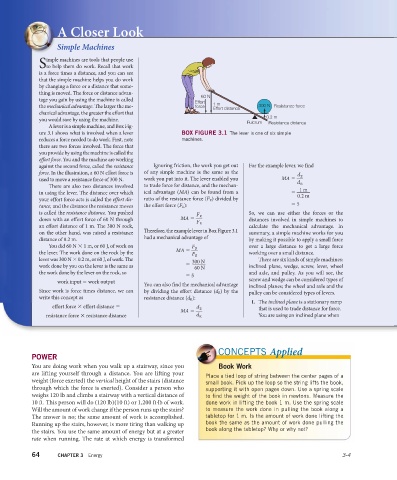
                        A lever is a simple machine, and Box Fig-
                     ure 3.1 shows what is involved when a lever    BOX FIGURE 3.1  The lever is one of six simple
                     reduces a force needed to do work. First, note   machines.
                     there are two forces involved. The force that
                     you provide by using the machine is called the
                     effort force. You and the machine are working
                     against the second force, called the resistance   Ignoring friction, the work you get out   For the example lever, we find
                     force. In the illustration, a 60 N effort force is   of any simple machine is the same as the     d
                                                                                                            E _

                     used to move a resistance force of 300 N.  work you put into it. The lever enabled you   MA =
                                                                                                             d
                        There are also two distances involved   to trade force for distance, and the mechan-  R
                                                                                                           1 m


                     in using the lever. The distance over which   ical advantage (MA) can be found from a      =   _
                                                                                                           0.2 m
                     your effort force acts is called the effort dis-  ratio of the resistance force (F R )  divided by
                     tance, and the distance the resistance moves   the effort force (F E ):             = 5
                     is called the resistance distance. You pushed         F               So, we can use either the forces or the
                                                                          R _

                     down with an effort force of 60 N through      MA =                   distances involved in simple machines to
                                                                           F
                                                                          E
                     an effort distance of 1 m. The 300 N rock,                            calculate the mechanical advantage. In
                                                        Therefore, the example lever in Box  Figure 3.1
                     on the other hand, was raised a resistance                            summary, a simple machine works for you
                                                        had a mechanical advantage of
                     distance of 0.2 m.                                                    by making it possible to apply a small force
                        You did 60 N × 1 m, or 60 J, of work on           F                over a large distance to get a large force
                                                                         R _
                                                                  MA =

                     the lever. The work done on the rock by the          F                working over a small distance.
                                                                         E
                     lever was 300 N × 0.2 m, or 60 J, of work. The     300 N                 There are six kinds of simple machines:
                                                                        _
                     work done by you on the lever is the same as      =      60 N         inclined plane, wedge, screw, lever, wheel
                     the work done by the lever on the rock, so                            and axle, and pulley. As you will see, the
                                                                      = 5
                           work input = work output                                        screw and wedge can be considered types of
                                                        You can also find the mechanical advantage   inclined planes; the wheel and axle and the
                     Since work is force times distance, we can   by dividing the effort distance (d E ) by the   pulley can be considered types of levers.
                     write this concept as                resistance distance (d R ):
                                                                                            1.  The inclined plane is a stationary ramp
                          effort force × effort distance =                 d
                                                                          E _
                                                                    MA =                      that is used to trade distance for force.

                       resistance force × resistance distance              d                  You are using an inclined plane when
                                                                          R
                                                                                CONCEPTS Applied
                   POWER
                   You are doing work when you walk up a stairway, since you    Book Work
                   are lifting yourself through a distance. You are lifting your
                                                                            Place a tied loop of string between the center pages of a
                   weight (force exerted) the vertical height of the stairs (distance   small book. Pick up the loop so the string lifts the book,
                   through which the force is exerted). Consider a person who     supporting it with open pages down. Use a spring scale
                   weighs 120 lb and climbs a stairway with a vertical distance of   to find the weight of the book in newtons. Measure the
                   10 ft. This person will do (120 lb)(10 ft) or 1,200 ft·lb of work.   done work in lifting the book 1 m. Use the spring scale
                   Will the amount of work change if the person runs up the stairs?   to measure the work done in pulling the book along a
                   The answer is no; the same amount of work is accomplished.   tabletop for 1 m. Is the amount of work done lifting the
                   Running up the stairs, however, is more tiring than walking up   book the same as the amount of work done pulling the
                   the stairs. You use the same amount of energy but at a greater   book along the tabletop? Why or why not?
                   rate when running. The rate at which energy is transformed
                   64      CHAPTER 3 Energy                                                                               3-4

