


Page 90 - 9780077418427.pdf
P. 90
/Users/user-f465/Desktop
          tiL12214_ch03_061-084.indd Page Sec3:67  9/1/10  9:33 PM user-f465
          tiL12214_ch03_061-084.indd Page Sec3:67  9/1/10  9:33 PM user-f465                                            /Users/user-f465/Desktop


                                                                               The higher the shelf, the greater the potential for the book
                         3.2  MOTION, POSITION, AND ENERGY
                                                                               to do work. The ability to do work is defined as energy. The
                       Closely related to the concept of work is the concept of energy.     energy that an object has because of its position is called
                       Energy can be defined as the ability to do work. This definition     potential energy (PE). Potential energy is defined as energy
                       of energy seems consistent with everyday ideas about energy   due to position. This is called gravitational potential energy,
                       and physical work. After all, it takes a lot of energy to do a lot of   since it is a result of gravitational attraction. There are other
                       work. In fact, one way of measuring the energy of something is   types of potential energy, such as that in a compressed or
                       to see how much work it can do. Likewise, when work is done   stretched spring.
                       on something, a change occurs in its energy level. The following   Note the relationship between work and energy in the ex-
                       examples will help clarify this close relationship between work   ample. You did 10 J of work to raise the book to a higher shelf. In
                       and energy.                                             so doing, you increased the potential energy of the book by 10 J.
                                                                               The book now has the potential of doing 10 J of additional work
                                                                               on something else; therefore,
                       POTENTIAL ENERGY
                                                                                 work done on                          increase  in
                       Consider a book on the floor next to a bookcase. You can do                  increase in
                                                                                  an object to   =               =  work the object
                       work on the book by vertically raising it to a shelf. You can mea-          potential energy
                                                                                 change position                         can do
                       sure this work by multiplying the vertical upward force applied
                       by the distance that the book is moved. You might find, for ex-    work on book  =  potential energy   =   work by book
                       ample, that you did an amount of work equal to 10 J on the book               of book
                       (see example 3.1).                                           (10 J)            (10 J)              (10 J)
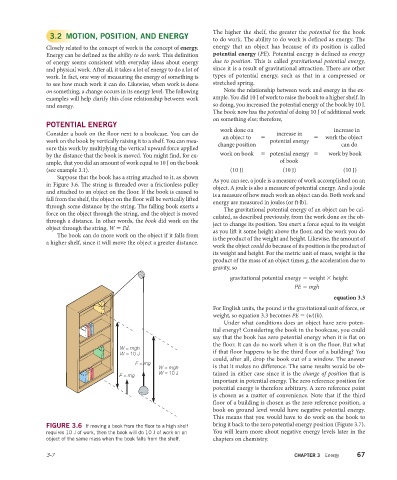
                           Suppose that the book has a string attached to it, as shown
                                                                               As you can see, a joule is a measure of work accomplished on an
                       in Figure 3.6. The string is threaded over a frictionless pulley
                                                                               object. A joule is also a measure of potential energy. And a joule
                       and attached to an object on the floor. If the book is caused to
                                                                               is a measure of how much work an object can do. Both work and
                       fall from the shelf, the object on the floor will be vertically lifted
                                                                               energy are measured in joules (or ft·lb).
                       through some distance by the string. The falling book exerts a
                                                                                  The gravitational potential energy of an object can be cal-
                       force on the object through the string, and the object is moved
                                                                               culated, as described previously, from the work done on the ob-
                       through a distance. In other words, the book did work on the
                                                                               ject to change its position. You exert a force equal to its weight
                       object through the string, W = Fd.
                                                                               as you lift it some height above the floor, and the work you do
                           The book can do more work on the object if it falls from
                                                                               is the product of the weight and height. Likewise, the amount of
                       a higher shelf, since it will move the object a greater distance.
                                                                               work the object could do because of its position is the product of
                                                                               its weight and height. For the metric unit of mass, weight is the
                                                                               product of the mass of an object times g, the acceleration due to
                                                                               gravity, so
                                                                                    gravitational potential energy = weight × height
                                                                                                          PE = mgh
                                                                                                                       equation 3.3
                                                                               For English units, the pound is the gravitational unit of force, or
                                                                               weight, so equation 3.3 becomes PE = (w)(h).
                                                                                  Under what conditions does an object have zero poten-
                                                                               tial energy? Considering the book in the bookcase, you could
                                                                               say that the book has zero potential energy when it is flat on
                                                                               the floor. It can do no work when it is on the floor. But what
                                                W = mgh
                                                W = 10 J                       if that floor happens to be the third floor of a building? You
                                                                               could,  after all, drop the book out of a window. The answer
                                                     F = mg
                                                             W = mgh           is that it makes no difference. The same results would be ob-
                                                F = mg       W = 10 J          tained in  either case since it is the change of position that is
                                                                               important in potential energy. The zero reference position for
                                                                               potential  energy is therefore arbitrary. A zero reference point
                                                                               is chosen as a matter of convenience. Note that if the third
                                                                               floor of a building is chosen as the zero reference position, a
                                                                               book on ground level would have negative potential energy.
                                                                               This means that you would have to do work on the book to
                                                                               bring it back to the zero potential energy position (Figure 3.7).
                       FIGURE 3.6  If moving a book from the floor to a high shelf
                        requires 10 J of work, then the book will do 10 J of work on an   You will learn more about negative energy levels later in the
                        object of the same mass when the book falls from the shelf.  chapters on chemistry.

                       3-7                                                                                CHAPTER 3  Energy   67

