


Page 91 - 9780077418427.pdf
P. 91
/Users/user-f465/Desktop
          tiL12214_ch03_061-084.indd Page Sec3:68  9/1/10  9:33 PM user-f465
          tiL12214_ch03_061-084.indd Page Sec3:68  9/1/10  9:33 PM user-f465                                            /Users/user-f465/Desktop


                                                                            your mass (conversion factors are  located inside the front
                                                  PE = mgh
                                                                            cover). Record your findings in your report.
                                              h                                Second, find your power output by climbing the stairs
                                                                            as fast as you can while someone measures the time with a
                                                     Reference position:
                                                     PE = 0                   stopwatch. Find your power output in watts. Convert this to
                                                                            horsepower by consulting the conversion factors inside the
                                                                            front cover. Did you develop at least 1 hp? Does a faster
                                                                            person always have more horsepower?
                                                                                                             2
                                                                                                 (     kg)(9.8 m∙ s   )(     m)
                                                                                                 ___

                                                                                   walking power =
                                                                                                        (     s)
                                                                                                             2
                                                                                                 (     kg)(9.8 m∙ s   )(     m)
                                                                                                 ___

                                                                                   running power =
                                                                                                        (     s)
                                      Ground level  PE = –mgh
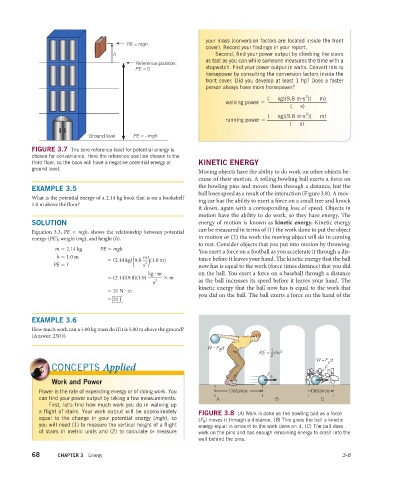
                   FIGURE 3.7  The zero reference level for potential energy is
                   chosen for convenience. Here the reference position chosen is the
                   third floor, so the book will have a negative potential energy at   KINETIC ENERGY
                   ground level.
                                                                          Moving objects have the ability to do work on other objects be-
                                                                          cause of their motion. A rolling bowling ball exerts a force on
                   EXAMPLE 3.5                                            the bowling pins and moves them through a distance, but the
                                                                          ball loses speed as a result of the interaction (Figure 3.8). A mov-
                   What is the potential energy of a 2.14 kg book that is on a bookshelf   ing car has the ability to exert a force on a small tree and knock
                   1.0 m above the floor?
                                                                          it down, again with a corresponding loss of speed. Objects in
                                                                          motion have the ability to do work, so they have energy. The
                   SOLUTION                                               energy of motion is known as kinetic energy.  Kinetic energy
                   Equation 3.3, PE = mgh, shows the relationship between potential   can be measured in terms of (1) the work done to put the object
                   energy (PE), weight (mg), and height (h).              in motion or (2) the work the moving object will do in coming
                                                                          to rest. Consider objects that you put into motion by throwing.
                          m = 2.14 kg      PE = mgh
                                                                          You exert a force on a football as you accelerate it through a dis-
                           h = 1.0 m                   m _
                                                    (
                                                        2)
                                            = (2.14 kg)  9.8           (1.0 m)  tance before it leaves your hand. The kinetic energy that the ball
                          PE = ?                         s                now has is equal to the work (force times distance) that you did
                                                         kg · m           on the ball. You exert a force on a baseball through a distance
                                                         _


                                            = (2.14)(9.8)(1.0)       × m
                                                            2
                                                            s             as the ball increases its speed before it leaves your hand. The
                                                                          kinetic energy that the ball now has is equal to the work that
                                            = 21 N  · m
                                                                          you did on the ball. The ball exerts a force on the hand of the
                                            = 21 J
                   EXAMPLE 3.6
                   How much work can a 5.00 kg mass do if it is 5.00 m above the ground?
                   (Answer: 250 J)
                                                                             W = F d
                                                                                 B                1  2
                                                                                              KE =    mv
                                                                                                  2
                                                                                                                 W = F d
                                                                                                                     p
                         CONCEPTS Applied                                                                           F p
                                                                                                 F
                                                                                                  B
                         Work and Power
                     Power is the rate of expending energy or of doing work. You    Distance                   Distance
                     can find your power output by taking a few measurements.   A                  B              C
                        First, let's find how much work you do in walking up
                     a flight of stairs. Your work output will be approximately   FIGURE 3.8  (A) Work is done on the bowling ball as a force
                     equal to the change in your potential energy (mgh), so   (F B ) moves it through a distance. (B) This gives the ball a kinetic
                     you will need (1) to measure the vertical height of a flight   energy equal in amount to the work done on it. (C) The ball does
                     of stairs in metric units and (2) to calculate or measure   work on the pins and has enough remaining energy to crash into the
                                                                          wall behind the pins.

                   68      CHAPTER 3 Energy                                                                               3-8

