


Page 88 - 9780077418427.pdf
P. 88
/Users/user-f465/Desktop
          tiL12214_ch03_061-084.indd Page Sec3:65  9/1/10  9:33 PM user-f465
          tiL12214_ch03_061-084.indd Page Sec3:65  9/1/10  9:33 PM user-f465                                            /Users/user-f465/Desktop


                             you climb a stairway, drive a road that
                                                             E                 R            R         E             E        R
                             switches back and forth when going up
                             a mountainside, or use a board to slide
                             a heavy box up to a loading dock. Each
                             use gives a large mechanical advan-  First-class lever    Second-class lever      Third-class lever
                             tage by trading  distance for force. For
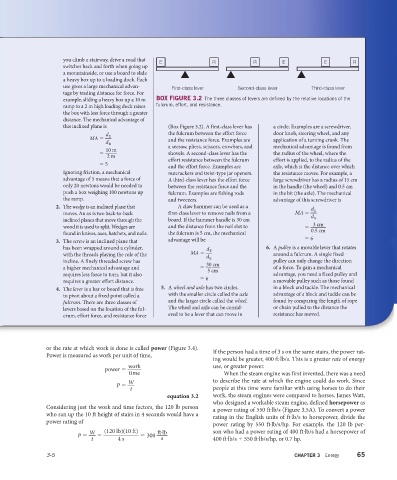
                             example,  sliding a heavy box up a 10 m   BOX FIGURE 3.2  The three classes of levers are defined by the relative locations of the
                             ramp to a 2 m high loading dock raises   fulcrum, effort, and resistance.
                             the box with less force through a greater
                             distance. The mechanical advantage of
                             this inclined plane is             (Box Figure 3.2). A first-class lever has   a circle.  Examples are a screwdriver,
                                            E _
                                             d                  the  fulcrum between the effort force   door knob, steering wheel, and any
                                      MA =                      and the resistance force. Examples are   application of a turning crank. The

                                             d
                                            R
                                           _                    a seesaw, pliers, scissors, crowbars, and   mechanical  advantage is found from
                                           10 m
                                         =                        shovels. A second-class lever has the   the radius of the wheel, where the
                                            2 m
                                                                  effort  resistance between the fulcrum   effort is applied, to the radius of the
                                         = 5
                                                                and the effort force. Examples are   axle, which is the distance over which
                              Ignoring friction, a mechanical   nutcrackers and twist-type jar openers.   the resistance moves. For example, a
                               advantage of 5 means that a force of   A third-class lever has the effort force   large  screwdriver has a radius of 15 cm
                             only 20 newtons would be needed to   between the  resistance force and the   in the handle (the wheel) and 0.5 cm
                             push a box weighing 100 newtons up   fulcrum. Examples are fishing rods   in the bit (the axle). The mechanical
                             the ramp.                          and tweezers.                        advantage of this screwdriver is
                            2. The wedge is an inclined plane that          A claw hammer can be used as a       d
                                                                                                                E _

                             moves. An ax is two back-to-back   first-class lever to remove nails from a   MA =
                                                                                                                 d
                               inclined planes that move through the   board. If the hammer handle is 30 cm     R
                                                                                                                3 cm
                             wood it is used to split. Wedges are   and the distance from the nail slot to      =   _


                             found in knives, axes, hatchets, and nails.  the fulcrum is 5 cm, the mechanical   0.5 cm
                            3. The screw is an inclined plane that   advantage will be                       = 6
                             has been wrapped around a cylinder,               d                 6. A pulley is a movable lever that rotates
                                                                              E _

                             with the threads playing the role of the   MA =                       around a fulcrum. A single fixed
                                                                               d
                                                                              R
                               incline. A finely threaded screw has         _                      pulley can only change the direction

                             a higher mechanical advantage and            =   30 cm                of a force. To gain a mechanical
                                                                             5 cm
                               requires less force to turn, but it also                            advantage, you need a fixed pulley and
                                                                          = 6
                             requires a greater effort distance.                                   a movable  pulley such as those found
                            4. The lever is a bar or board that is free     5. A wheel and axle has two circles,   in a block and tackle. The mechanical
                             to pivot about a fixed point called a   with the smaller circle called the axle   advantage of a block and tackle can be
                               fulcrum. There are three classes of   and the larger circle called the wheel.   found by  comparing the length of rope
                             levers based on the location of the ful-  The wheel and axle can be consid-  or chain pulled to the distance the
                             crum,  effort force, and resistance force   ered to be a lever that can move in   resistance has moved.
                       or the rate at which work is done is called power (Figure 3.4).
                                                                               If the person had a time of 3 s on the same stairs, the power rat-
                       Power is measured as work per unit of time,
                                                                               ing would be greater, 400 ft·lb/s. This is a greater rate of energy
                                                  _                            use, or greater power.
                                                   work
                                           power =
                                                   time                           When the steam engine was first invented, there was a need
                                                   W _                         to describe the rate at which the engine could do work. Since

                                                P =
                                                   t                           people at this time were familiar with using horses to do their
                                                                equation 3.2   work, the steam engines were compared to horses. James Watt,
                                                                               who designed a workable steam engine, defined horsepower as
                       Considering just the work and time factors, the 120 lb person
                                                                               a power rating of 550 ft·lb/s (Figure 3.5A). To convert a power
                       who ran up the 10 ft height of stairs in 4 seconds would have a
                                                                               rating in the English units of ft·lb/s to horsepower, divide the
                       power rating of
                                                                               power rating by 550 ft·lb/s/hp. For example, the 120 lb per-
                                           (120 lb)(10 ft)
                                      W _  __               _                  son who had a power rating of 400 ft·lb/s had a horsepower of
                                                            ft·lb

                                  P =       =
                                                       = 300

                                      t        4 s            s                400 ft·lb/s ÷ 550 ft·lb/s/hp, or 0.7 hp.
                       3-5                                                                                CHAPTER 3  Energy   65

