


Page 122 - HOW TO PROVE IT: A Structured Approach, Second Edition
P. 122
P1: PIG/
                   0521861241c03  CB996/Velleman  October 20, 2005  2:42  0 521 86124 1  Char Count= 0


                                   108                         Proofs
                                                   3.3. Proofs Involving Quantifiers

                                   Look again at Example 3.2.3. In that example we said that x could be any-
                                   thing at all, and we proved the statement x ∈ A \ C → x ∈ B. Because the
                                   reasoning we used would apply no matter what x was, our proof actually shows
                                   that x ∈ A \ C → x ∈ B is true for all x. In other words, we can conclude
                                   ∀x(x ∈ A \ C → x ∈ B).
                                     This illustrates the easiest and most straightforward way of proving a goal
                                   of the form ∀xP(x). If you can give a proof of the goal P(x) that would work
                                   no matter what x was, then you can conclude that ∀xP(x) must be true. To
                                   make sure that your proof would work for any value of x, it is important to
                                   start your proof with no assumptions about x. Mathematicians express this by
                                   saying that x must be arbitrary. In particular, you must not assume that x is
                                   equal to any other object already under discussion in the proof. Thus, if the
                                   letter x is already being used in the proof to stand for some particular object,
                                   then you cannot use it to stand for an arbitrary object. In this case you must
                                   choose a different variable that is not already being used in the proof, say y,
                                   and replace the goal ∀xP(x) with the equivalent statement ∀yP(y). Now you
                                   can proceed by letting y stand for an arbitrary object and proving P(y).

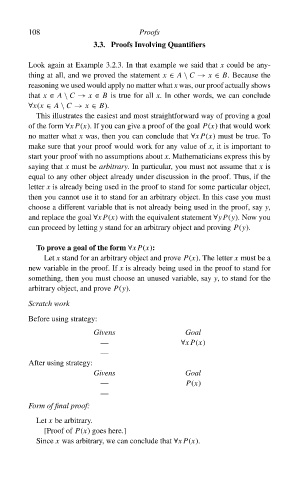
                                     To prove a goal of the form ∀xP(x):
                                       Let x stand for an arbitrary object and prove P(x). The letter x must be a
                                   new variable in the proof. If x is already being used in the proof to stand for
                                   something, then you must choose an unused variable, say y, to stand for the
                                   arbitrary object, and prove P(y).

                                   Scratch work
                                   Before using strategy:

                                                   Givens                  Goal
                                                     —                    ∀xP(x)
                                                     —
                                   After using strategy:
                                                   Givens                  Goal
                                                     —                     P(x)
                                                     —
                                   Form of final proof:

                                     Let x be arbitrary.
                                       [Proof of P(x) goes here.]
                                     Since x was arbitrary, we can conclude that ∀xP(x).

