


Page 127 - HOW TO PROVE IT: A Structured Approach, Second Edition
P. 127
P1: PIG/
                   0521861241c03  CB996/Velleman  October 20, 2005  2:42  0 521 86124 1  Char Count= 0


                                                Proofs Involving Quantifiers            113
                              Finding the right value to use for x may be difficult in some cases. One
                            method that is sometimes helpful is to assume that P(x) is true and then see
                            if you can figure out what x must be, based on this assumption. If P(x)isan
                            equation involving x, this amounts to solving the equation for x. However, if
                            this doesn’t work, you may use any other method you please to try to find a
                            value to use for x, including trial-and-error and guessing. The reason you have
                            such freedom with this step is that the reasoning you use to find a value for x
                            will not appear in the final proof. This is because of our rule that a proof should
                            only contain the reasoning needed to justify the conclusion of the proof, not
                            an explanation of how you thought of that reasoning. To justify the conclusion
                            that ∃xP(x) is true it is only necessary to verify that P(x) comes out true when
                            x is assigned some particular value. How you thought of that value is your own
                            business, and not part of the justification of the conclusion.


                            Example 3.3.3. Prove that for every real number x,if x > 0 then there is a
                            real number y such that y(y + 1) = x.

                            Scratch work
                            In symbols, our goal is ∀x(x > 0 →∃y[y(y + 1) = x]), where the variables
                            x and y in this statement are understood to range over R. We therefore start by
                            letting x be an arbitrary real number, and we then assume that x > 0 and try
                            to prove that ∃y[y(y + 1) = x]. Thus, we now have the following given and
                            goal:
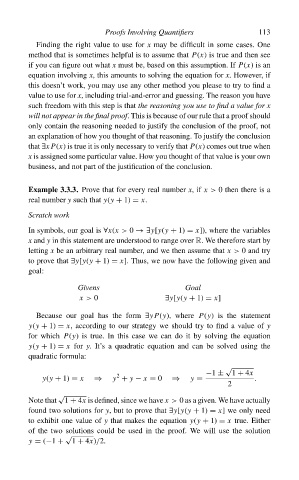
                                         Givens                     Goal
                                         x > 0                 ∃y[y(y + 1) = x]

                              Because our goal has the form ∃yP(y), where P(y) is the statement
                            y(y + 1) = x, according to our strategy we should try to find a value of y
                            for which P(y) is true. In this case we can do it by solving the equation
                            y(y + 1) = x for y. It’s a quadratic equation and can be solved using the
                            quadratic formula:
                                                                              √
                                                   2
                                y(y + 1) = x  ⇒   y + y − x = 0  ⇒   y =  −1 ±  1 + 4x  .
                                                                               2
                                    √
                            Note that  1 + 4x is defined, since we have x > 0 as a given. We have actually
                            found two solutions for y, but to prove that ∃y[y(y + 1) = x] we only need
                            to exhibit one value of y that makes the equation y(y + 1) = x true. Either
                            of the two solutions could be used in the proof. We will use the solution
                                     √
                            y = (−1 +  1 + 4x)/2.

