


Page 125 - HOW TO PROVE IT: A Structured Approach, Second Edition
P. 125
P1: PIG/
                   0521861241c03  CB996/Velleman  October 20, 2005  2:42  0 521 86124 1  Char Count= 0


                                                Proofs Involving Quantifiers            111
                            In a proof in which several of these strategies have been combined, there might
                            be several of these summing up sentences, one after another, at the end of the
                            proof. Mathematicians often condense this summing up into one sentence, or
                            even skip it entirely. When you are reading a proof written by someone else,
                            you may find it helpful to fill in these skipped steps.


                            Example 3.3.2. Suppose A and B are sets. Prove that if A ∩ B = A then
                            A ⊆ B.

                            Scratch work
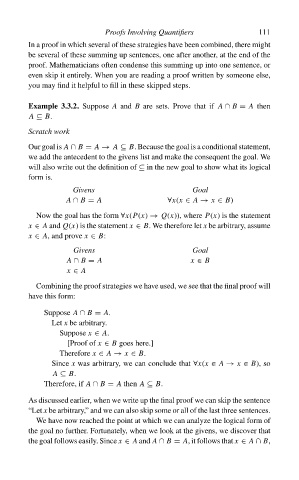
                            Our goal is A ∩ B = A → A ⊆ B. Because the goal is a conditional statement,
                            we add the antecedent to the givens list and make the consequent the goal. We
                            will also write out the definition of ⊆ in the new goal to show what its logical
                            form is.
                                       Givens                         Goal
                                      A ∩ B = A                 ∀x(x ∈ A → x ∈ B)

                              Now the goal has the form ∀x(P(x) → Q(x)), where P(x) is the statement
                            x ∈ A and Q(x) is the statement x ∈ B. We therefore let x be arbitrary, assume
                            x ∈ A, and prove x ∈ B:
                                       Givens                         Goal
                                      A ∩ B = A                      x ∈ B
                                      x ∈ A
                              Combining the proof strategies we have used, we see that the final proof will
                            have this form:
                                Suppose A ∩ B = A.
                                  Let x be arbitrary.
                                    Suppose x ∈ A.
                                      [Proof of x ∈ B goes here.]
                                    Therefore x ∈ A → x ∈ B.
                                  Since x was arbitrary, we can conclude that ∀x(x ∈ A → x ∈ B), so
                                  A ⊆ B.
                                Therefore, if A ∩ B = A then A ⊆ B.
                            As discussed earlier, when we write up the final proof we can skip the sentence
                            “Let x be arbitrary,” and we can also skip some or all of the last three sentences.
                              We have now reached the point at which we can analyze the logical form of
                            the goal no further. Fortunately, when we look at the givens, we discover that
                            the goal follows easily. Since x ∈ A and A ∩ B = A, it follows that x ∈ A ∩ B,

