


Page 128 - HOW TO PROVE IT: A Structured Approach, Second Edition
P. 128
P1: PIG/
                   0521861241c03  CB996/Velleman  October 20, 2005  2:42  0 521 86124 1  Char Count= 0


                                   114                         Proofs
                                     The steps we’ve used to solve for y should not appear in the final proof. In the
                                                                         √
                                   final proof we will simply say “Let y = (−1 +  1 + 4x)/2” and then prove
                                   that y(y + 1) = x. In other words, the final proof will have this form:

                                         Let x be an arbitrary real number.
                                           Suppose x > 0.
                                                         √
                                             Let y = (−1 +  1 + 4x)/2.
                                               [Proof of y(y + 1) = x goes here.]
                                             Thus, ∃y[y(y + 1) = x].
                                           Therefore x > 0 →∃y[y(y + 1) = x].
                                         Since x was arbitrary, we can conclude that ∀x(x > 0 →∃y[y(y + 1)
                                       = x]).

                                     To see what must be done to fill in the remaining gap in the proof, we add
                                            √
                                   y = (−1 +  1 + 4x)/2 to the givens list and make y(y + 1) = x the goal:
                                                 Givens                         Goal
                                            x > 0                            y(y + 1) = x
                                                     √
                                                −1 +  1 + 4x
                                            y =
                                                     2
                                     We can now prove that the equation y(y + 1) = x is true by simply sub-
                                               √
                                   stituting (−1 +  1 + 4x)/2 for y and verifying that the resulting equation is
                                   true.

                                   Solution

                                   Theorem. For every real number x, if x > 0 then there is a real number y such
                                   that y(y + 1) = x.
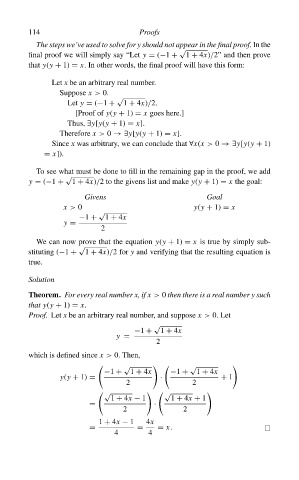
                                   Proof. Let x be an arbitrary real number, and suppose x > 0. Let
                                                                   √
                                                              −1 +  1 + 4x
                                                         y =
                                                                   2
                                   which is defined since x > 0. Then,
                                                           √                √
                                                      −1 +   1 + 4x    −1 +  1 + 4x
                                           y(y + 1) =               ·               + 1
                                                            2               2
                                                       √              √
                                                        1 + 4x − 1     1 + 4x + 1
                                                  =                ·
                                                           2              2
                                                     1 + 4x − 1  4x
                                                  =           =     = x.
                                                         4       4

