


Page 145 - HOW TO PROVE IT: A Structured Approach, Second Edition
P. 145
P1: PIG/
                   0521861241c03  CB996/Velleman  October 20, 2005  2:42  0 521 86124 1  Char Count= 0


                                       Proofs Involving Conjunctions and Biconditionals  131
                            might try to shorten the proof by writing it as a string of equivalences, starting
                            with x ∈ A ∩ (B \ C) and ending with x ∈ (A ∩ B) \ C. In this case, if we
                            start with x ∈ A ∩ (B \ C) and follow the first string of equivalences displayed
                            above, we come to a statement that is the same as the last statement in the
                            second string of equivalences. We can then continue by following the second
                            string of equivalences backward, ending with x ∈ (A ∩ B) \ C.
                            Solution

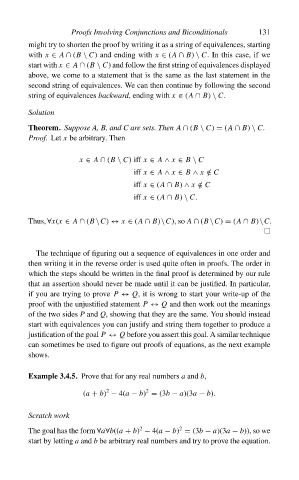
                            Theorem. Suppose A, B, and C are sets. Then A ∩ (B \ C) = (A ∩ B) \ C.
                            Proof. Let x be arbitrary. Then


                                         x ∈ A ∩ (B \ C)iff x ∈ A ∧ x ∈ B \ C
                                                       iff x ∈ A ∧ x ∈ B ∧ x /∈ C
                                                       iff x ∈ (A ∩ B) ∧ x /∈ C
                                                       iff x ∈ (A ∩ B) \ C.


                            Thus, ∀x(x ∈ A ∩ (B \C) ↔ x ∈ (A ∩ B)\C), so A ∩ (B \C) = (A ∩ B)\C.


                              The technique of figuring out a sequence of equivalences in one order and
                            then writing it in the reverse order is used quite often in proofs. The order in
                            which the steps should be written in the final proof is determined by our rule
                            that an assertion should never be made until it can be justified. In particular,
                            if you are trying to prove P ↔ Q, it is wrong to start your write-up of the
                            proof with the unjustified statement P ↔ Q and then work out the meanings
                            of the two sides P and Q, showing that they are the same. You should instead
                            start with equivalences you can justify and string them together to produce a
                            justification of the goal P ↔ Q before you assert this goal. A similar technique
                            can sometimes be used to figure out proofs of equations, as the next example
                            shows.

                            Example 3.4.5. Prove that for any real numbers a and b,

                                                2         2
                                          (a + b) − 4(a − b) = (3b − a)(3a − b).

                            Scratch work
                                                        2
                                                                  2
                            The goal has the form ∀a∀b((a + b) − 4(a − b) = (3b − a)(3a − b)), so we
                            start by letting a and b be arbitrary real numbers and try to prove the equation.

