


Page 146 - HOW TO PROVE IT: A Structured Approach, Second Edition
P. 146
P1: PIG/
                   0521861241c03  CB996/Velleman  October 20, 2005  2:42  0 521 86124 1  Char Count= 0


                                   132                         Proofs
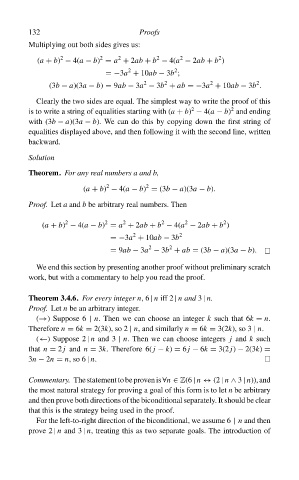
                                   Multiplying out both sides gives us:
                                                                   2
                                                                         2
                                                                                   2
                                                     2
                                           2
                                                         2
                                     (a + b) − 4(a − b) = a + 2ab + b − 4(a − 2ab + b )
                                                            2
                                                                        2
                                                      =−3a + 10ab − 3b ;
                                                                     2
                                                                                 2
                                                                2
                                                                                             2
                                        (3b − a)(3a − b) = 9ab − 3a − 3b + ab =−3a + 10ab − 3b .
                                     Clearly the two sides are equal. The simplest way to write the proof of this
                                                                            2
                                                                                      2
                                   is to write a string of equalities starting with (a + b) − 4(a − b) and ending
                                   with (3b − a)(3a − b). We can do this by copying down the first string of
                                   equalities displayed above, and then following it with the second line, written
                                   backward.
                                   Solution
                                   Theorem. For any real numbers a and b,
                                                      2          2
                                                 (a + b) − 4(a − b) = (3b − a)(3a − b).
                                   Proof. Let a and b be arbitrary real numbers. Then
                                                      2
                                                                     2
                                                                                    2
                                                           2
                                            2
                                                                           2
                                      (a + b) − 4(a − b) = a + 2ab + b − 4(a − 2ab + b )
                                                             2
                                                       =−3a + 10ab − 3b  2
                                                                 2
                                                                       2
                                                       = 9ab − 3a − 3b + ab = (3b − a)(3a − b).
                                     We end this section by presenting another proof without preliminary scratch
                                   work, but with a commentary to help you read the proof.
                                   Theorem 3.4.6. For every integer n, 6 | n iff 2 | n and 3 | n.
                                   Proof. Let n be an arbitrary integer.
                                     (→) Suppose 6 | n. Then we can choose an integer k such that 6k = n.
                                   Therefore n = 6k = 2(3k), so 2 | n, and similarly n = 6k = 3(2k), so 3 | n.
                                     (←) Suppose 2 | n and 3 | n. Then we can choose integers j and k such
                                   that n = 2 j and n = 3k. Therefore 6( j − k) = 6 j − 6k = 3(2 j) − 2(3k) =
                                   3n − 2n = n,so6 | n.

                                   Commentary. Thestatementtobeprovenis∀n ∈ Z(6 | n ↔ (2 | n ∧ 3 | n)),and
                                   the most natural strategy for proving a goal of this form is to let n be arbitrary
                                   and then prove both directions of the biconditional separately. It should be clear
                                   that this is the strategy being used in the proof.
                                     For the left-to-right direction of the biconditional, we assume 6 | n and then
                                   prove 2 | n and 3 | n, treating this as two separate goals. The introduction of

