


Page 150 - HOW TO PROVE IT: A Structured Approach, Second Edition
P. 150
P1: PIG/
                   0521861241c03  CB996/Velleman  October 20, 2005  2:42  0 521 86124 1  Char Count= 0


                                   136                         Proofs
                                                   3.5. Proofs Involving Disjunctions

                                   Suppose one of your givens in a proof has the form P ∨ Q. This given tells
                                   you that either P or Q is true, but it doesn’t tell you which. Thus, there are two
                                   possibilities that you must take into account. One way to do the proof would
                                   be to consider these two possibilities in turn. In other words, first assume that
                                   P is true and use this assumption to prove your goal. Then assume Q is true
                                   and give another proof that the goal is true. Although you don’t know which of
                                   these assumptions is correct, the given P ∨ Q tells you that one of them must
                                   be correct. Whichever one it is, you have shown that it implies the goal. Thus,
                                   the goal must be true.
                                     The two possibilities that are considered separately in this type of proof –
                                   the possibility that P is true and the possibility that Q is true – are called cases.
                                   The given P ∨ Q justifies the use of these two cases by guaranteeing that these
                                   cases cover all of the possibilities. Mathematicians say in this situation that the
                                   cases are exhaustive. Any proof can be broken into two or more cases at any
                                   time, as long as the cases are exhaustive.

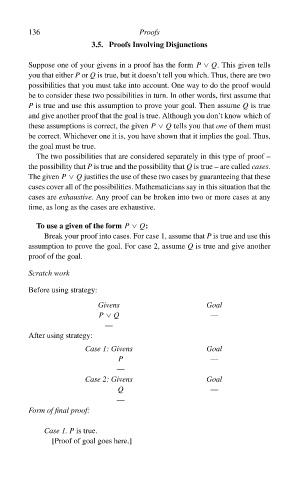
                                     To use a given of the form P ∨ Q:
                                       Break your proof into cases. For case 1, assume that P is true and use this
                                   assumption to prove the goal. For case 2, assume Q is true and give another
                                   proof of the goal.
                                   Scratch work

                                   Before using strategy:
                                                    Givens                      Goal
                                                     P ∨ Q                       —
                                                      —
                                   After using strategy:
                                                 Case 1: Givens                 Goal
                                                          P                      —
                                                         —
                                                 Case 2: Givens                 Goal
                                                         Q                       —
                                                         —
                                   Form of final proof:

                                       Case 1. P is true.
                                         [Proof of goal goes here.]

