


Page 174 - HOW TO PROVE IT: A Structured Approach, Second Edition
P. 174
P1: PIG/
                   0521861241c03  CB996/Velleman  October 20, 2005  2:42  0 521 86124 1  Char Count= 0


                                   160                         Proofs
                                           Since x was arbitrary, we can conclude that ∀x(0 < |x − 3| <δ →
                                              2
                                             2x −5x−3  − 7 <ε).

                                             x−3
                                                                             2

                                                                             2x −5x−3
                                         Therefore ∃δ> 0∀x 0 < |x − 3| <δ →        − 7 <ε .

                                                                              x−3

                                       Since ε was arbitrary, it follows that ∀ε> 0∃δ> 0∀x 0 < |x − 3| <
                                              2
                                       δ →    2x −5x−3  − 7 <ε .

                                              x−3
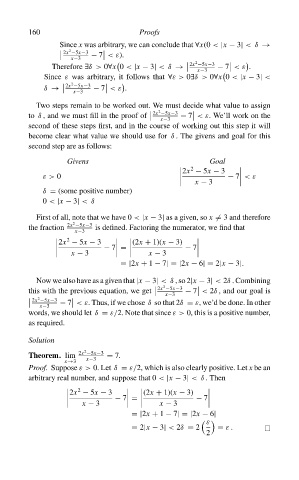
                                     Two steps remain to be worked out. We must decide what value to assign
                                                                    2


                                   to δ , and we must fill in the proof of    2x −5x−3  − 7 <ε. We’ll work on the

                                                                    x−3
                                   second of these steps first, and in the course of working out this step it will
                                   become clear what value we should use for δ . The givens and goal for this
                                   second step are as follows:
                                            Givens                               Goal
                                                                            2
                                                                           2x − 5x − 3
                                      ε> 0                                           − 7 <ε

                                                                             x − 3

                                      δ = (some positive number)
                                      0 < |x − 3| <δ
                                     First of all, note that we have 0 < |x − 3| as a given, so x  = 3 and therefore
                                              2
                                   the fraction  2x −5x−3  is defined. Factoring the numerator, we find that
                                              x−3
                                           2x − 5x − 3        (2x + 1)(x − 3)
                                            2

                                                      − 7 =                − 7
                                             x − 3               x − 3
                                                          =|2x + 1 − 7|=|2x − 6|= 2|x − 3|.
                                     Now we also have as a given that |x − 3| <δ ,so2|x − 3| < 2δ . Combining
                                                                      2
                                   this with the previous equation, we get    2x −5x−3  − 7 < 2δ , and our goal is

                                                                     x−3
                                     2
                                     2x −5x−3  − 7 <ε. Thus, if we chose δ so that 2δ = ε, we’d be done. In other


                                     x−3
                                   words, we should let δ = ε/2. Note that since ε> 0, this is a positive number,
                                   as required.
                                   Solution
                                                 2
                                   Theorem. lim  2x −5x−3  = 7.
                                            x→3  x−3
                                   Proof. Suppose ε> 0. Let δ = ε/2, which is also clearly positive. Let x be an
                                   arbitrary real number, and suppose that 0 < |x − 3| <δ . Then
                                               2
                                              2x − 5x − 3          (2x + 1)(x − 3)


                                                         − 7 =               − 7

                                                x − 3               x − 3

                                                             =|2x + 1 − 7|=|2x − 6|
                                                                                ε

                                                             = 2|x − 3| < 2δ = 2   = ε.
                                                                                2

