


Page 169 - HOW TO PROVE IT: A Structured Approach, Second Edition
P. 169
P1: PIG/
                   0521861241c03  CB996/Velleman  October 20, 2005  2:42  0 521 86124 1  Char Count= 0


                                                 More Examples of Proofs               155
                                              3.7. More Examples of Proofs

                            So far, most of our proofs have involved fairly straightforward applications of
                            the proof techniques we’ve discussed. We end this chapter with a few exam-
                            ples of somewhat more difficult proofs. These proofs use the techniques of this
                            chapter, but for various reasons they’re a little harder than most of our earlier
                            proofs. Some are simply longer, involving the application of more proof strate-
                            gies. Some require clever choices of which strategies to use. In some cases it’s
                            clear what strategy to use, but some insight is required to see exactly how to
                            use it. Our earlier examples, which were intended only to illustrate and clarify
                            the proof techniques, may have made proof-writing seem mechanical and dull.
                            We hope that by studying these more difficult examples you will begin to see
                            that mathematical reasoning can also be surprising and beautiful.
                              Some proof techniques are particularly difficult to apply. For example, when
                            you’re proving a goal of the form ∃xP(x), the obvious way to proceed is to try
                            to find a value of x that makes the statement P(x) true, but sometimes it will
                            not be obvious how to find that value of x. Using a given of the form ∀xP(x)is
                            similar. You’ll probably want to plug in a particular value for x, but to complete
                            the proof you may have to make a clever choice of what to plug in. Proofs that
                            must be broken down into cases are also sometimes difficult to figure out. It is
                            sometimes hard to know when to use cases and what cases to use.
                              We begin by looking again at the proofs from the introduction. Some aspects
                            of these proofs probably seemed somewhat mysterious when you read them
                            in the introduction. See if they make more sense to you now that you have a
                            better understanding of how proofs are constructed. We will present each proof
                            exactly as it appeared in the introduction and then follow it with a commentary
                            discussing the proof techniques used.


                            Theorem 3.7.1. Suppose n is an integer larger than 1 and n is not prime. Then
                             n
                            2 − 1 is not prime.
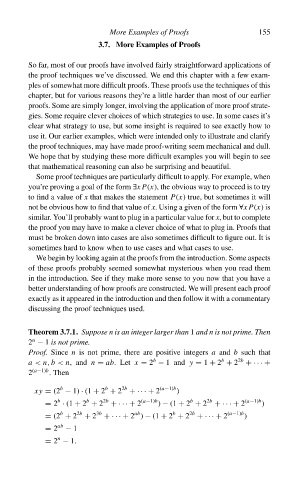
                            Proof. Since n is not prime, there are positive integers a and b such that
                                                            b                b   2b
                            a < n, b < n, and n = ab. Let x = 2 − 1 and y = 1 + 2 + 2 + ··· +
                            2 (a−1)b . Then

                                    b
                                                b
                                                    2b
                              xy = (2 − 1) · (1 + 2 + 2 +· · · + 2 (a−1)b )
                                               2b
                                                                     b
                                                                          2b
                                           b
                                   b
                                = 2 · (1 + 2 + 2 +· · · + 2 (a−1)b ) − (1 + 2 + 2 +· · · + 2 (a−1)b )
                                                       ab
                                                                 b
                                                                     2b
                                             3b
                                    b
                                        2b
                                = (2 + 2 + 2 + ··· + 2 ) − (1 + 2 + 2 +· · · + 2 (a−1)b )
                                = 2 ab  − 1
                                   n
                                = 2 − 1.

