


Page 196 - HOW TO PROVE IT: A Structured Approach, Second Edition
P. 196
P1: PIG/  P2: OYK/
                   0521861241c04  CB996/Velleman  October 20, 2005  2:54  0 521 86124 1  Char Count= 0


                                   182                        Relations
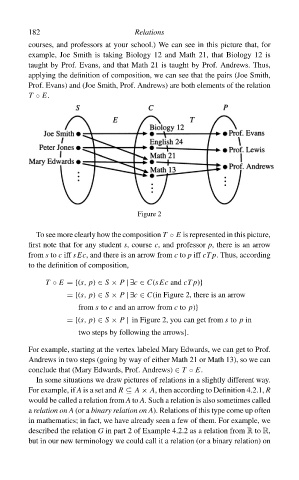
                                   courses, and professors at your school.) We can see in this picture that, for
                                   example, Joe Smith is taking Biology 12 and Math 21, that Biology 12 is
                                   taught by Prof. Evans, and that Math 21 is taught by Prof. Andrews. Thus,
                                   applying the definition of composition, we can see that the pairs (Joe Smith,
                                   Prof. Evans) and (Joe Smith, Prof. Andrews) are both elements of the relation
                                   T ◦ E.


                                                              Figure 2

                                     To see more clearly how the composition T ◦ E is represented in this picture,
                                   first note that for any student s, course c, and professor p, there is an arrow
                                   from s to c iff sEc, and there is an arrow from c to p iff cT p. Thus, according
                                   to the definition of composition,

                                       T ◦ E ={(s, p) ∈ S × P |∃c ∈ C(sEc and cT p)}
                                            ={(s, p) ∈ S × P |∃c ∈ C(in Figure 2, there is an arrow
                                               from s to c and an arrow from c to p)}
                                            ={(s, p) ∈ S × P | in Figure 2, you can get from s to p in
                                               two steps by following the arrows}.
                                   For example, starting at the vertex labeled Mary Edwards, we can get to Prof.
                                   Andrews in two steps (going by way of either Math 21 or Math 13), so we can
                                   conclude that (Mary Edwards, Prof. Andrews) ∈ T ◦ E.
                                     In some situations we draw pictures of relations in a slightly different way.
                                   For example, if A is a set and R ⊆ A × A, then according to Definition 4.2.1, R
                                   would be called a relation from A to A. Such a relation is also sometimes called
                                   a relation on A (or a binary relation on A). Relations of this type come up often
                                   in mathematics; in fact, we have already seen a few of them. For example, we
                                   described the relation G in part 2 of Example 4.2.2 as a relation from R to R,
                                   but in our new terminology we could call it a relation (or a binary relation) on

