


Page 197 - HOW TO PROVE IT: A Structured Approach, Second Edition
P. 197
P1: PIG/  P2: OYK/
                   0521861241c04  CB996/Velleman  October 20, 2005  2:54  0 521 86124 1  Char Count= 0


                                                  More About Relations                 183
                            R. The relation E −1  ◦ E from Example 4.2.4 was a relation on the set S, and
                            E ◦ E −1  was a relation on C.

                            Example 4.3.1. Here are some more examples of relations on sets.

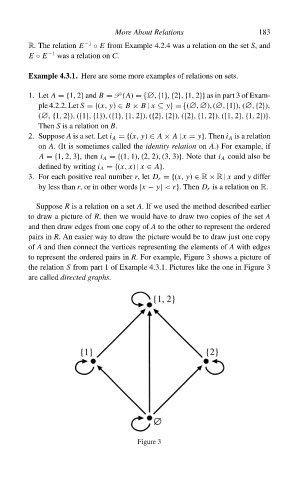
                            1. Let A ={1, 2} and B = P (A) = {∅, {1}, {2}, {1, 2}} as in part 3 of Exam-
                               ple 4.2.2. Let S ={(x, y) ∈ B × B | x ⊆ y}= {(∅,∅), (∅, {1}), (∅, {2}),
                               (∅, {1, 2}), ({1}, {1}), ({1}, {1, 2}), ({2}, {2}), ({2}, {1, 2}), ({1, 2}, {1, 2})}.
                               Then S is a relation on B.
                            2. Suppose A is a set. Let i A ={(x, y) ∈ A × A | x = y}. Then i A is a relation
                               on A. (It is sometimes called the identity relation on A.) For example, if
                               A ={1, 2, 3}, then i A ={(1, 1), (2, 2), (3, 3)}. Note that i A could also be
                               defined by writing i A ={(x, x) | x ∈ A}.
                            3. For each positive real number r, let D r ={(x, y) ∈ R × R | x and y differ
                               by less than r, or in other words |x − y| < r}. Then D r is a relation on R.


                              Suppose R is a relation on a set A. If we used the method described earlier
                            to draw a picture of R, then we would have to draw two copies of the set A
                            and then draw edges from one copy of A to the other to represent the ordered
                            pairs in R. An easier way to draw the picture would be to draw just one copy
                            of A and then connect the vertices representing the elements of A with edges
                            to represent the ordered pairs in R. For example, Figure 3 shows a picture of
                            the relation S from part 1 of Example 4.3.1. Pictures like the one in Figure 3
                            are called directed graphs.


                                                        Figure 3

