


Page 200 - HOW TO PROVE IT: A Structured Approach, Second Edition
P. 200
P1: PIG/  P2: OYK/
                   0521861241c04  CB996/Velleman  October 20, 2005  2:54  0 521 86124 1  Char Count= 0


                                   186                        Relations
                                                      −1
                                   must prove that R = R , and this is done by proving both R ⊆ R −1  and
                                   R −1  ⊆ R. Each of these goals is proven by taking an arbitrary element of the
                                   first set and showing that it is in the second set. In the ← half we must prove
                                   that R is symmetric, which means ∀x ∈ A∀y ∈ A(xRy → yRx). We use the
                                   obvious strategy of letting x and y be arbitrary elements of A, assuming xRy,
                                   and proving yRx.


                                                              Exercises

                                    ∗
                                     1. Let L ={a, b, c, d, e} and W ={bad, bed, cab}. Let R ={(l, w) ∈
                                       L × W | the letter l occurs in the word w}. Draw a diagram (like the
                                       one in Figure 1) of R.
                                     2. Let A = {cat, dog, bird, rat}, and let R ={(x, y) ∈ A × A | there is at least
                                       one letter that occurs in both of the words x and y}. Draw a directed graph
                                       (like the one in Figure 3) for the relation R.Is R reflexive? symmetric?
                                       transitive?
                                    ∗
                                     3. Let A ={1, 2, 3, 4}. Draw a directed graph for the identity relation on
                                       A, i A .
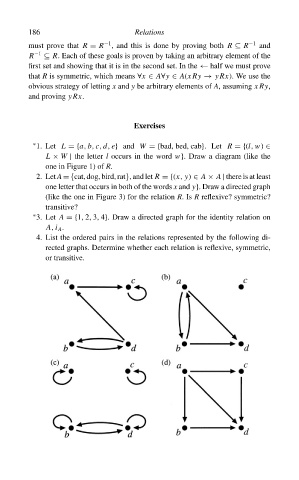
                                     4. List the ordered pairs in the relations represented by the following di-
                                       rected graphs. Determine whether each relation is reflexive, symmetric,
                                       or transitive.

