


Page 201 - HOW TO PROVE IT: A Structured Approach, Second Edition
P. 201
P1: PIG/  P2: OYK/
                   0521861241c04  CB996/Velleman  October 20, 2005  2:54  0 521 86124 1  Char Count= 0


                                                  More About Relations                 187
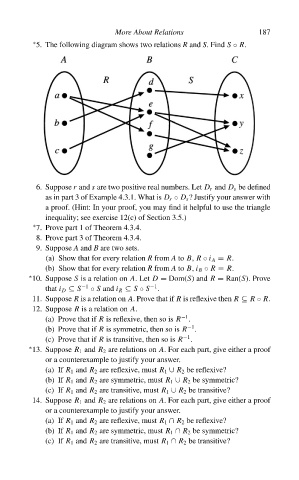
                              5. The following diagram shows two relations R and S. Find S ◦ R.
                             ∗


                              6. Suppose r and s are two positive real numbers. Let D r and D s be defined
                                as in part 3 of Example 4.3.1. What is D r ◦ D s ? Justify your answer with
                                a proof. (Hint: In your proof, you may find it helpful to use the triangle
                                inequality; see exercise 12(c) of Section 3.5.)
                              7. Prove part 1 of Theorem 4.3.4.
                             ∗
                              8. Prove part 3 of Theorem 4.3.4.
                              9. Suppose A and B are two sets.
                                (a) Show that for every relation R from A to B, R ◦ i A = R.
                                (b) Show that for every relation R from A to B, i B ◦ R = R.
                             10. Suppose S is a relation on A. Let D = Dom(S) and R = Ran(S). Prove
                            ∗
                                                           −1
                                that i D ⊆ S −1  ◦ S and i R ⊆ S ◦ S .
                             11. Suppose R is a relation on A. Prove that if R is reflexive then R ⊆ R ◦ R.
                             12. Suppose R is a relation on A.
                                                                   −1
                                (a) Prove that if R is reflexive, then so is R .
                                                                     −1
                                (b) Prove that if R is symmetric, then so is R .
                                                                   −1
                                (c) Prove that if R is transitive, then so is R .
                             13. Suppose R 1 and R 2 are relations on A. For each part, give either a proof
                            ∗
                                or a counterexample to justify your answer.
                                (a) If R 1 and R 2 are reflexive, must R 1 ∪ R 2 be reflexive?
                                (b) If R 1 and R 2 are symmetric, must R 1 ∪ R 2 be symmetric?
                                (c) If R 1 and R 2 are transitive, must R 1 ∪ R 2 be transitive?
                             14. Suppose R 1 and R 2 are relations on A. For each part, give either a proof
                                or a counterexample to justify your answer.
                                (a) If R 1 and R 2 are reflexive, must R 1 ∩ R 2 be reflexive?
                                (b) If R 1 and R 2 are symmetric, must R 1 ∩ R 2 be symmetric?
                                (c) If R 1 and R 2 are transitive, must R 1 ∩ R 2 be transitive?

