


Page 278 - HOW TO PROVE IT: A Structured Approach, Second Edition
P. 278
P1: Oyk/
                   0521861241c06  CB996/Velleman  October 20, 2005  1:8  0 521 86124 1  Char Count= 0


                                   264                  Mathematical Induction
                                                                               3
                                                          3
                                     Base case: If n = 0, then n − n = 0 = 3 · 0, so 3 | (n − n).
                                                                                           3
                                     Induction step: Let n be an arbitrary natural number and suppose 3 | (n − n).
                                                                          3
                                   Then we can choose an integer k such that 3k = n − n. Thus,
                                                                3
                                                                      2
                                                   3
                                              (n + 1) − (n + 1) = n + 3n + 3n + 1 − n − 1
                                                                 3         2
                                                             = (n − n) + 3n + 3n
                                                                      2
                                                             = 3k + 3n + 3n
                                                                     2
                                                             = 3(k + n + n).
                                                    3
                                   Therefore 3 | ((n + 1) − (n + 1)), as required.
                                     Once you understand why mathematical induction works, you should be able
                                   to understand proofs that involve small variations on the method of induction.
                                   The next example illustrates such a variation. In this example we’ll try to figure
                                                        n
                                                   2
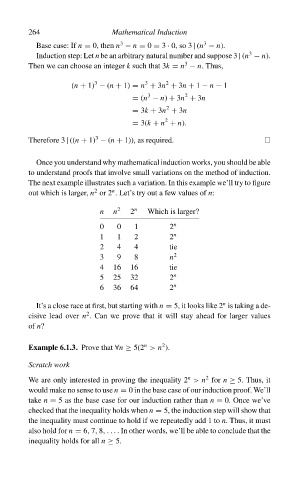
                                   out which is larger, n or 2 . Let’s try out a few values of n:
                                                     n  n 2  2 n  Which is larger?

                                                     0   0    1        2 n
                                                     1   1    2        2 n
                                                     2   4    4        tie
                                                     3   9    8        n 2
                                                     4  16   16        tie
                                                     5  25   32        2 n
                                                     6  36   64        2 n

                                                                                    n
                                     It’s a close race at first, but starting with n = 5, it looks like 2 is taking a de-
                                                 2
                                   cisive lead over n . Can we prove that it will stay ahead for larger values
                                   of n?

                                                                     2
                                                                n
                                   Example 6.1.3. Prove that ∀n ≥ 5(2 > n ).
                                   Scratch work
                                                                                2
                                                                           n
                                   We are only interested in proving the inequality 2 > n for n ≥ 5. Thus, it
                                   would make no sense to use n = 0 in the base case of our induction proof. We’ll
                                   take n = 5 as the base case for our induction rather than n = 0. Once we’ve
                                   checked that the inequality holds when n = 5, the induction step will show that
                                   the inequality must continue to hold if we repeatedly add 1 to n. Thus, it must
                                   also hold for n = 6, 7, 8,.... In other words, we’ll be able to conclude that the
                                   inequality holds for all n ≥ 5.

