


Page 281 - HOW TO PROVE IT: A Structured Approach, Second Edition
P. 281
P1: Oyk/
                   0521861241c06  CB996/Velleman  October 20, 2005  1:8  0 521 86124 1  Char Count= 0


                                                     More Examples                     267
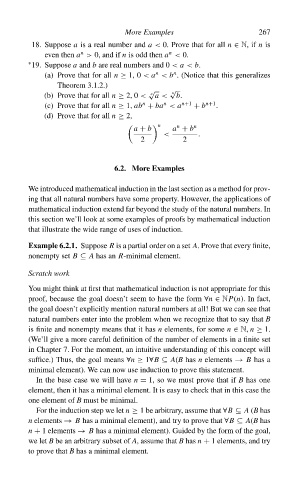
                             18. Suppose a is a real number and a < 0. Prove that for all n ∈ N,if n is
                                         n
                                                                n
                                even then a > 0, and if n is odd then a < 0.
                            ∗ 19. Suppose a and b are real numbers and 0 < a < b.
                                                                 n
                                                            n
                                (a) Prove that for all n ≥ 1, 0 < a < b . (Notice that this generalizes
                                   Theorem 3.1.2.)
                                                           √    √
                                (b) Prove that for all n ≥ 2, 0 <  n  a <  n  b.
                                                         n
                                                               n
                                (c) Prove that for all n ≥ 1, ab + ba < a n+1  + b n+1 .
                                (d) Prove that for all n ≥ 2,
                                                              n   n   n
                                                       a + b     a + b
                                                              <        .
                                                         2         2
                                                  6.2. More Examples


                            We introduced mathematical induction in the last section as a method for prov-
                            ing that all natural numbers have some property. However, the applications of
                            mathematical induction extend far beyond the study of the natural numbers. In
                            this section we’ll look at some examples of proofs by mathematical induction
                            that illustrate the wide range of uses of induction.

                            Example 6.2.1. Suppose R is a partial order on a set A. Prove that every finite,
                            nonempty set B ⊆ A has an R-minimal element.

                            Scratch work

                            You might think at first that mathematical induction is not appropriate for this
                            proof, because the goal doesn’t seem to have the form ∀n ∈ NP(n). In fact,
                            the goal doesn’t explicitly mention natural numbers at all! But we can see that
                            natural numbers enter into the problem when we recognize that to say that B
                            is finite and nonempty means that it has n elements, for some n ∈ N, n ≥ 1.
                            (We’ll give a more careful definition of the number of elements in a finite set
                            in Chapter 7. For the moment, an intuitive understanding of this concept will
                            suffice.) Thus, the goal means ∀n ≥ 1∀B ⊆ A(B has n elements → B has a
                            minimal element). We can now use induction to prove this statement.
                              In the base case we will have n = 1, so we must prove that if B has one
                            element, then it has a minimal element. It is easy to check that in this case the
                            one element of B must be minimal.
                              For the induction step we let n ≥ 1 be arbitrary, assume that ∀B ⊆ A (B has
                            n elements → B has a minimal element), and try to prove that ∀B ⊆ A(B has
                            n + 1 elements → B has a minimal element). Guided by the form of the goal,
                            we let B be an arbitrary subset of A, assume that B has n + 1 elements, and try
                            to prove that B has a minimal element.

