


Page 280 - HOW TO PROVE IT: A Structured Approach, Second Edition
P. 280
P1: Oyk/
                   0521861241c06  CB996/Velleman  October 20, 2005  1:8  0 521 86124 1  Char Count= 0


                                   266                  Mathematical Induction
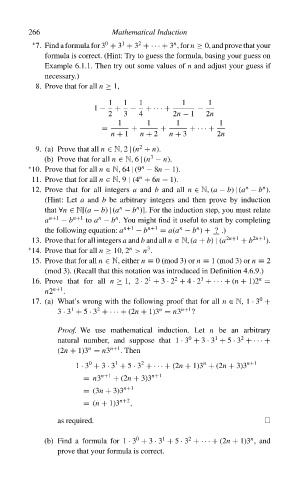
                                    7. Find a formula for 3 + 3 + 3 +· · · + 3 , for n ≥ 0, and prove that your
                                    ∗                 0   1    2        n
                                       formula is correct. (Hint: Try to guess the formula, basing your guess on
                                       Example 6.1.1. Then try out some values of n and adjust your guess if
                                       necessary.)
                                    8. Prove that for all n ≥ 1,

                                                       1   1   1          1     1
                                                   1 −   +   −  +· · · +      −
                                                       2   3   4       2n − 1   2n
                                                         1       1      1          1
                                                     =       +      +       + ··· +
                                                        n + 1  n + 2   n + 3       2n
                                                               2
                                    9. (a) Prove that all n ∈ N, 2 | (n + n).
                                                                  3
                                       (b) Prove that for all n ∈ N, 6 | (n − n).
                                   ∗                           n
                                   10. Prove that for all n ∈ N, 64 | (9 − 8n − 1).
                                                               n
                                   11. Prove that for all n ∈ N,9 | (4 + 6n − 1).
                                                                                          n
                                                                                              n
                                   12. Prove that for all integers a and b and all n ∈ N, (a − b) | (a − b ).
                                       (Hint: Let a and b be arbitrary integers and then prove by induction
                                                          n
                                                              n
                                       that ∀n ∈ N[(a − b) | (a − b )]. For the induction step, you must relate
                                                         n
                                                    n
                                       a n+1  − b n+1  to a − b . You might find it useful to start by completing
                                                                             n
                                                                         n
                                       the following equation: a n+1  − b n+1  = a(a − b ) + ? .)
                                   13. Prove that for all integers a and b and all n ∈ N,(a + b) | (a 2n+1  + b 2n+1 ).
                                                                 3
                                                            n
                                   ∗ 14. Prove that for all n ≥ 10, 2 > n .
                                   15. Prove that for all n ∈ N, either n ≡ 0 (mod 3) or n ≡ 1 (mod 3) or n ≡ 2
                                       (mod 3). (Recall that this notation was introduced in Definition 4.6.9.)
                                                                 1      2      3             n
                                   16. Prove that for all n ≥ 1, 2 · 2 + 3 · 2 + 4 · 2 +· · · + (n + 1)2 =
                                       n2 n+1 .
                                                                                              0
                                   17. (a) What’s wrong with the following proof that for all n ∈ N,1 · 3 +
                                             1
                                                    2
                                                                    n
                                          3 · 3 + 5 · 3 +· · · + (2n + 1)3 = n3 n+1 ?
                                          Proof. We use mathematical induction. Let n be an arbitrary
                                                                           0      1      2
                                          natural number, and suppose that 1 · 3 + 3 · 3 + 5 · 3 +· · · +
                                                  n
                                          (2n + 1)3 = n3 n+1 . Then
                                                                               n
                                                  0
                                                         1
                                                               2
                                               1 · 3 + 3 · 3 + 5 · 3 +· · · + (2n + 1)3 + (2n + 3)3 n+1
                                                 = n3 n+1  + (2n + 3)3 n+1
                                                 = (3n + 3)3 n+1
                                                 = (n + 1)3 n+2 ,
                                          as required.
                                                                                           n
                                                                     1
                                                                           2
                                                              0
                                       (b) Find a formula for 1 · 3 + 3 · 3 + 5 · 3 + ··· + (2n + 1)3 , and
                                          prove that your formula is correct.

