


Page 344 - HOW TO PROVE IT: A Structured Approach, Second Edition
P. 344
P1: PIG/
                   0521861241apx01  CB996/Velleman  October 20, 2005  2:56  0 521 86124 1  Char Count= 0


                                   330          Appendix 1: Solutions to Selected Exercises
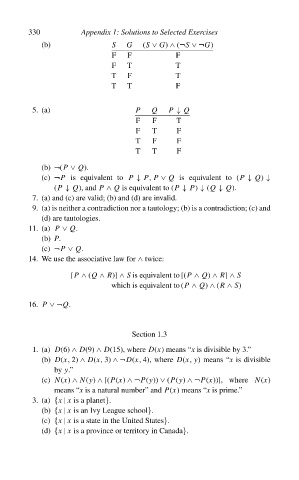
                                      (b)               S   G   (S ∨ G) ∧ (¬S ∨¬G)
                                                        F   F           F
                                                        F   T           T
                                                        T   F           T
                                                        T   T           F


                                    5. (a)                    P   Q   P ↓ Q
                                                              F   F     T
                                                              F   T     F
                                                              T   F     F
                                                              T   T     F
                                      (b) ¬(P ∨ Q).
                                      (c) ¬P is equivalent to P ↓ P, P ∨ Q is equivalent to (P ↓ Q) ↓
                                         (P ↓ Q), and P ∧ Q is equivalent to (P ↓ P) ↓ (Q ↓ Q).
                                    7. (a) and (c) are valid; (b) and (d) are invalid.
                                    9. (a) is neither a contradiction nor a tautology; (b) is a contradiction; (c) and
                                      (d) are tautologies.
                                   11. (a) P ∨ Q.
                                      (b) P.
                                      (c) ¬P ∨ Q.
                                   14. We use the associative law for ∧ twice:
                                             [P ∧ (Q ∧ R)] ∧ S is equivalent to [(P ∧ Q) ∧ R] ∧ S
                                                        which is equivalent to (P ∧ Q) ∧ (R ∧ S)

                                   16. P ∨¬Q.


                                                             Section 1.3
                                    1. (a) D(6) ∧ D(9) ∧ D(15), where D(x) means “x is divisible by 3.”
                                      (b) D(x, 2) ∧ D(x, 3) ∧¬D(x, 4), where D(x, y) means “x is divisible
                                         by y.”
                                      (c) N(x) ∧ N(y) ∧ [(P(x) ∧¬P(y)) ∨ (P(y) ∧¬P(x))], where N(x)
                                         means “x is a natural number” and P(x) means “x is prime.”
                                    3. (a) {x | x is a planet}.
                                      (b) {x | x is an Ivy League school}.
                                      (c) {x | x is a state in the United States}.
                                      (d) {x | x is a province or territory in Canada}.

