


Page 346 - HOW TO PROVE IT: A Structured Approach, Second Edition
P. 346
P1: PIG/
                   0521861241apx01  CB996/Velleman  October 20, 2005  2:56  0 521 86124 1  Char Count= 0


                                   332          Appendix 1: Solutions to Selected Exercises
                                    8. Sets (a), (d), and (e) are equal, and sets (b) and (c) are equal.
                                   10. (a) There is no region corresponding to the set (A ∩ D) \ (B ∪ C), but this
                                         set could have elements.
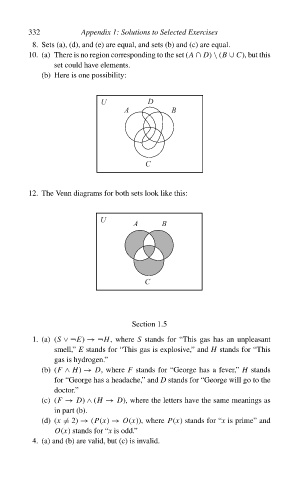
                                      (b) Here is one possibility:


                                                     U           D
                                                           A           B


                                                                C


                                   12. The Venn diagrams for both sets look like this:


                                                     U
                                                             A       B


                                                                C


                                                             Section 1.5

                                    1. (a) (S ∨¬E) →¬H, where S stands for “This gas has an unpleasant
                                         smell,” E stands for “This gas is explosive,” and H stands for “This
                                         gas is hydrogen.”
                                      (b) (F ∧ H) → D, where F stands for “George has a fever,” H stands
                                         for “George has a headache,” and D stands for “George will go to the
                                         doctor.”
                                      (c) (F → D) ∧ (H → D), where the letters have the same meanings as
                                         in part (b).
                                      (d) (x  = 2) → (P(x) → O(x)), where P(x) stands for “x is prime” and
                                         O(x) stands for “x is odd.”
                                    4. (a) and (b) are valid, but (c) is invalid.

