


Page 371 - HOW TO PROVE IT: A Structured Approach, Second Edition
P. 371
P1: PIG/
                   0521861241apx01  CB996/Velleman  October 20, 2005  2:56  0 521 86124 1  Char Count= 0


                                         Appendix 1: Solutions to Selected Exercises   357
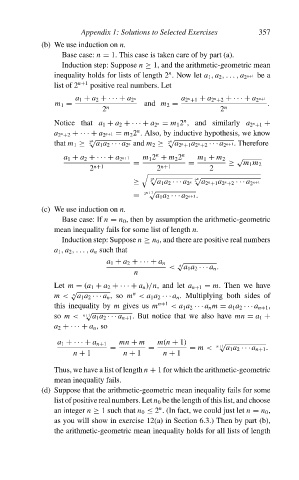
                               (b) We use induction on n.
                                     Base case: n = 1. This case is taken care of by part (a).
                                     Induction step: Suppose n ≥ 1, and the arithmetic-geometric mean
                                                                n
                                   inequality holds for lists of length 2 . Now let a 1 , a 2 ,..., a 2 n+1 be a
                                   list of 2 n+1  positive real numbers. Let
                                                                     n
                                                                           n
                                        a 1 + a 2 +· · · + a 2 n   a 2 +1 + a 2 +2 + ··· + a 2 n+1
                                   m 1 =                  and m 2 =                      .
                                               2 n                           2 n
                                                                    n
                                                             n
                                   Notice that a 1 + a 2 +· · · + a 2 = m 1 2 , and similarly a 2 +1 +
                                                                                     n
                                                        n
                                    n
                                   a 2 +2 +· · · + a 2 n+1 = m 2 2 . Also, by inductive hypothesis, we know
                                            √                   √
                                            2 n
                                                                   n
                                                                       n
                                   that m 1 ≥  a 1 a 2 ··· a 2 and m 2 ≥  2 n  a 2 +1 a 2 +2 ··· a 2 n+1. Therefore
                                                      n
                                                             n
                                     a 1 + a 2 +· · · + a 2 n+1  m 1 2 + m 2 2 n  m 1 + m 2  √
                                                       =             =         ≥   m 1 m 2
                                            2 n+1            2 n+1        2

                                                           2 n √      2 n √
                                                       ≥     a 1 a 2 ··· a 2 n  a 2 +1 a 2 +2 ··· a 2 n+1
                                                                              n
                                                                          n
                                                         2 n+1 √
                                                       =    a 1 a 2 ··· a 2 n+1.
                               (c) We use induction on n.
                                     Base case: If n = n 0 , then by assumption the arithmetic-geometric
                                   mean inequality fails for some list of length n.
                                     Induction step: Suppose n ≥ n 0 , and there are positive real numbers
                                   a 1 , a 2 ,..., a n such that
                                                a 1 + a 2 +· · · + a n  √
                                                                <  n  a 1 a 2 ··· a n .
                                                       n
                                   Let m = (a 1 + a 2 +· · · + a n )/n, and let a n+1 = m. Then we have
                                       √               n
                                   m <  n  a 1 a 2 ··· a n ,so m < a 1 a 2 ··· a n . Multiplying both sides of
                                   this inequality by m gives us m n+1  < a 1 a 2 ··· a n m = a 1 a 2 ··· a n+1 ,
                                           √
                                   so m <  n+1  a 1 a 2 ··· a n+1 . But notice that we also have mn = a 1 +
                                   a 2 +· · · + a n ,so
                                   a 1 +· · · + a n+1  mn + m  m(n + 1)      √
                                                 =         =         = m <  n+1  a 1 a 2 ··· a n+1 .
                                       n + 1        n + 1     n + 1
                                   Thus, we have a list of length n + 1 for which the arithmetic-geometric
                                   mean inequality fails.
                               (d) Suppose that the arithmetic-geometric mean inequality fails for some
                                   list of positive real numbers. Let n 0 be the length of this list, and choose
                                                             n
                                   an integer n ≥ 1 such that n 0 ≤ 2 . (In fact, we could just let n = n 0 ,
                                   as you will show in exercise 12(a) in Section 6.3.) Then by part (b),
                                   the arithmetic-geometric mean inequality holds for all lists of length

