


Page 50 - HOW TO PROVE IT: A Structured Approach, Second Edition
P. 50
P1: PIG/
                   0521861241c01  CB996/Velleman  October 19, 2005  23:46  0 521 86124 1  Char Count= 0


                                   36                      Sentential Logic
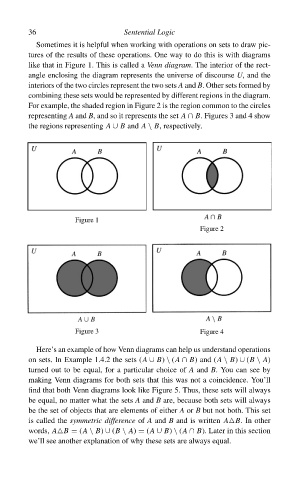
                                     Sometimes it is helpful when working with operations on sets to draw pic-
                                   tures of the results of these operations. One way to do this is with diagrams
                                   like that in Figure 1. This is called a Venn diagram. The interior of the rect-
                                   angle enclosing the diagram represents the universe of discourse U, and the
                                   interiors of the two circles represent the two sets A and B. Other sets formed by
                                   combining these sets would be represented by different regions in the diagram.
                                   For example, the shaded region in Figure 2 is the region common to the circles
                                   representing A and B, and so it represents the set A ∩ B. Figures 3 and 4 show
                                   the regions representing A ∪ B and A \ B, respectively.


                                               Figure 1
                                                                              Figure 2


                                               Figure 3                       Figure 4
                                     Here’s an example of how Venn diagrams can help us understand operations
                                   on sets. In Example 1.4.2 the sets (A ∪ B) \ (A ∩ B) and (A \ B) ∪ (B \ A)
                                   turned out to be equal, for a particular choice of A and B. You can see by
                                   making Venn diagrams for both sets that this was not a coincidence. You’ll
                                   find that both Venn diagrams look like Figure 5. Thus, these sets will always
                                   be equal, no matter what the sets A and B are, because both sets will always
                                   be the set of objects that are elements of either A or B but not both. This set
                                   is called the symmetric difference of A and B and is written A B. In other
                                   words, A B = (A \ B) ∪ (B \ A) = (A ∪ B) \ (A ∩ B). Later in this section
                                   we’ll see another explanation of why these sets are always equal.

