


Page 54 - HOW TO PROVE IT: A Structured Approach, Second Edition
P. 54
P1: PIG/
                   0521861241c01  CB996/Velleman  October 19, 2005  23:46  0 521 86124 1  Char Count= 0


                                   40                      Sentential Logic
                                   You can now check, using equivalences from Section 1.2, that these statements
                                   are equivalent. An alternative way to check the equivalence is with a truth table.
                                   To simplify the truth table, let’s use P and Q as abbreviations for the statements
                                   x ∈ A and x ∈ B. Then we must check that the formulas (P ∨ Q) ∧¬(P ∧ Q)
                                   and (P ∧¬Q) ∨ (Q ∧¬P) are equivalent. The truth table in Figure 7 shows
                                   this.


                                                              Figure 7


                                   Definition 1.4.5. Suppose A and B are sets. We will say that A is a subset of
                                   B if every element of A is also an element of B. We write A ⊆ B to mean that
                                   A is a subset of B. A and B are said to be disjoint if they have no elements in
                                   common. Note that this is the same as saying that the set of elements they have
                                   in common is the empty set, or in other words A ∩ B = ∅.

                                   Example 1.4.6. Suppose A = {red, green}, B = {red, yellow, green, purple},
                                   and C = {blue, purple}. Then the two elements of A, red and green, are both
                                   also in B, and therefore A ⊆ B. Also, A ∩ C = ∅,so A and C are disjoint.

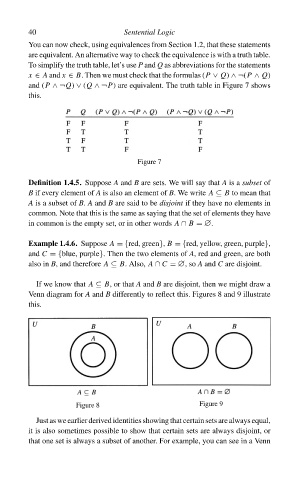
                                     If we know that A ⊆ B, or that A and B are disjoint, then we might draw a
                                   Venn diagram for A and B differently to reflect this. Figures 8 and 9 illustrate
                                   this.


                                               Figure 8                       Figure 9

                                     Justaswe earlier derivedidentities showingthat certain setsare alwaysequal,
                                   it is also sometimes possible to show that certain sets are always disjoint, or
                                   that one set is always a subset of another. For example, you can see in a Venn

