


Page 53 - HOW TO PROVE IT: A Structured Approach, Second Edition
P. 53
P1: PIG/
                   0521861241c01  CB996/Velleman  October 19, 2005  23:46  0 521 86124 1  Char Count= 0


                                                   Operations on Sets                   39


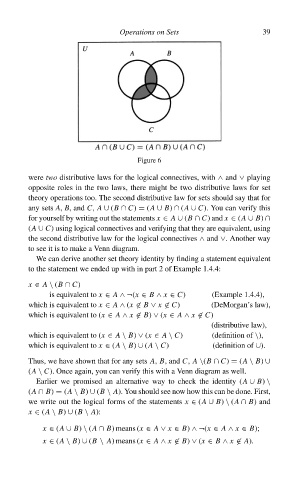
                                                        Figure 6

                            were two distributive laws for the logical connectives, with ∧ and ∨ playing
                            opposite roles in the two laws, there might be two distributive laws for set
                            theory operations too. The second distributive law for sets should say that for
                            any sets A, B, and C, A ∪ (B ∩ C) = (A ∪ B) ∩ (A ∪ C). You can verify this
                            for yourself by writing out the statements x ∈ A ∪ (B ∩ C) and x ∈ (A ∪ B) ∩
                            (A ∪ C) using logical connectives and verifying that they are equivalent, using
                            the second distributive law for the logical connectives ∧ and ∨. Another way
                            to see it is to make a Venn diagram.
                              We can derive another set theory identity by finding a statement equivalent
                            to the statement we ended up with in part 2 of Example 1.4.4:
                            x ∈ A \ (B ∩ C)
                                 is equivalent to x ∈ A ∧¬(x ∈ B ∧ x ∈ C)  (Example 1.4.4),
                            which is equivalent to x ∈ A ∧ (x  ∈ B ∨ x  ∈ C)  (DeMorgan’s law),
                            which is equivalent to (x ∈ A ∧ x  ∈ B) ∨ (x ∈ A ∧ x  ∈ C)
                                                                           (distributive law),
                            which is equivalent to (x ∈ A \ B) ∨ (x ∈ A \ C)  (definition of \),
                            which is equivalent to x ∈ (A \ B) ∪ (A \ C)   (definition of ∪).
                            Thus, we have shown that for any sets A, B, and C, A \(B ∩ C) = (A \ B) ∪
                            (A \ C). Once again, you can verify this with a Venn diagram as well.
                              Earlier we promised an alternative way to check the identity (A ∪ B) \
                            (A ∩ B) = (A \ B) ∪ (B \ A). You should see now how this can be done. First,
                            we write out the logical forms of the statements x ∈ (A ∪ B) \ (A ∩ B) and
                            x ∈ (A \ B) ∪ (B \ A):

                                x ∈ (A ∪ B) \ (A ∩ B) means (x ∈ A ∨ x ∈ B) ∧¬(x ∈ A ∧ x ∈ B);
                                x ∈ (A \ B) ∪ (B \ A) means (x ∈ A ∧ x  ∈ B) ∨ (x ∈ B ∧ x  ∈ A).

