


Page 51 - HOW TO PROVE IT: A Structured Approach, Second Edition
P. 51
P1: PIG/
                   0521861241c01  CB996/Velleman  October 19, 2005  23:46  0 521 86124 1  Char Count= 0


                                                   Operations on Sets                   37


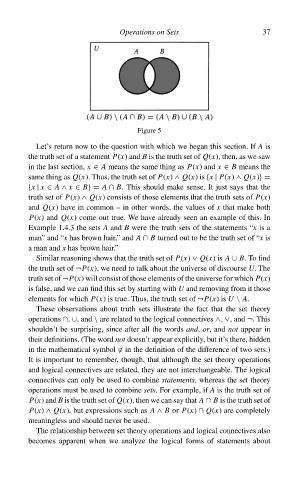
                                                        Figure 5
                              Let’s return now to the question with which we began this section. If A is
                            the truth set of a statement P(x) and B is the truth set of Q(x), then, as we saw
                            in the last section, x ∈ A means the same thing as P(x) and x ∈ B means the
                            same thing as Q(x). Thus, the truth set of P(x) ∧ Q(x)is {x | P(x) ∧ Q(x)}=
                            {x | x ∈ A ∧ x ∈ B}= A ∩ B. This should make sense. It just says that the
                            truth set of P(x) ∧ Q(x) consists of those elements that the truth sets of P(x)
                            and Q(x) have in common – in other words, the values of x that make both
                            P(x) and Q(x) come out true. We have already seen an example of this. In
                            Example 1.4.3 the sets A and B were the truth sets of the statements “x is a
                            man” and “x has brown hair,” and A ∩ B turned out to be the truth set of “x is
                            a man and x has brown hair.”
                              Similar reasoning shows that the truth set of P(x) ∨ Q(x)is A ∪ B. To find
                            the truth set of ¬P(x), we need to talk about the universe of discourse U. The
                            truth set of ¬P(x) will consist of those elements of the universe for which P(x)
                            is false, and we can find this set by starting with U and removing from it those
                            elements for which P(x) is true. Thus, the truth set of ¬P(x)is U \ A.
                              These observations about truth sets illustrate the fact that the set theory
                            operations ∩, ∪, and \ are related to the logical connectives ∧, ∨, and ¬. This
                            shouldn’t be surprising, since after all the words and, or, and not appear in
                            their definitions. (The word not doesn’t appear explicitly, but it’s there, hidden
                            in the mathematical symbol  ∈ in the definition of the difference of two sets.)
                            It is important to remember, though, that although the set theory operations
                            and logical connectives are related, they are not interchangeable. The logical
                            connectives can only be used to combine statements, whereas the set theory
                            operations must be used to combine sets. For example, if A is the truth set of
                            P(x) and B is the truth set of Q(x), then we can say that A ∩ B is the truth set of
                            P(x) ∧ Q(x), but expressions such as A ∧ B or P(x) ∩ Q(x) are completely
                            meaningless and should never be used.
                              The relationship between set theory operations and logical connectives also
                            becomes apparent when we analyze the logical forms of statements about

