


Page 60 - HOW TO PROVE IT: A Structured Approach, Second Edition
P. 60
P1: PIG/
                   0521861241c01  CB996/Velleman  October 19, 2005  23:46  0 521 86124 1  Char Count= 0


                                   46                      Sentential Logic
                                     Of course, there are many other values of x that could be plugged into our
                                                        2
                                   statement “If x > 2 then x > 4”; but if you try them, you’ll find that they all
                                   lead to line one, two, or four of the truth table, as our examples x = 1, −5,
                                   and 3 did. No value of x will lead to line three, because you could never have
                                            2
                                   x > 2but x ≤ 4. After all, that’s why we said that the statement “If x > 2
                                        2
                                   then x > 4” was always true, no matter what x was! The point of saying that
                                   this conditional statement is always true is simply to say that you will never
                                                                 2
                                   find a value of x such that x > 2 and x ≤ 4 – in other words, there is no value
                                   of x for which P(x) is true but Q(x) is false. Thus, it should make sense that
                                   in the truth table for P → Q, the only line that is false is the line in which P
                                   is true and Q is false.
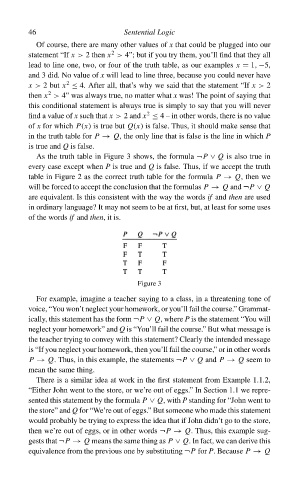
                                     As the truth table in Figure 3 shows, the formula ¬P ∨ Q is also true in
                                   every case except when P is true and Q is false. Thus, if we accept the truth
                                   table in Figure 2 as the correct truth table for the formula P → Q, then we
                                   will be forced to accept the conclusion that the formulas P → Q and ¬P ∨ Q
                                   are equivalent. Is this consistent with the way the words if and then are used
                                   in ordinary language? It may not seem to be at first, but, at least for some uses
                                   of the words if and then,itis.


                                                              Figure 3
                                     For example, imagine a teacher saying to a class, in a threatening tone of
                                   voice, “You won’t neglect your homework, or you’ll fail the course.” Grammat-
                                   ically, this statement has the form ¬P ∨ Q, where P is the statement “You will
                                   neglect your homework” and Q is “You’ll fail the course.” But what message is
                                   the teacher trying to convey with this statement? Clearly the intended message
                                   is “If you neglect your homework, then you’ll fail the course,” or in other words
                                   P → Q. Thus, in this example, the statements ¬P ∨ Q and P → Q seem to
                                   mean the same thing.
                                     There is a similar idea at work in the first statement from Example 1.1.2,
                                   “Either John went to the store, or we’re out of eggs.” In Section 1.1 we repre-
                                   sented this statement by the formula P ∨ Q, with P standing for “John went to
                                   the store” and Q for “We’re out of eggs.” But someone who made this statement
                                   would probably be trying to express the idea that if John didn’t go to the store,
                                   then we’re out of eggs, or in other words ¬P → Q. Thus, this example sug-
                                   gests that ¬P → Q means the same thing as P ∨ Q. In fact, we can derive this
                                   equivalence from the previous one by substituting ¬P for P. Because P → Q

