


Page 57 - PRE-U STPM BIOLOGY TERM 1
P. 57
Biology Term 1  STPM  Chapter 2 Structure of Cells and Organelles

                                                (ii)  Agranulocytes
                                                     •  Agranulocytes do not have granules in their cytoplasm.
                                                       They are formed in the bone marrow and then get into
                                                       the blood stream.
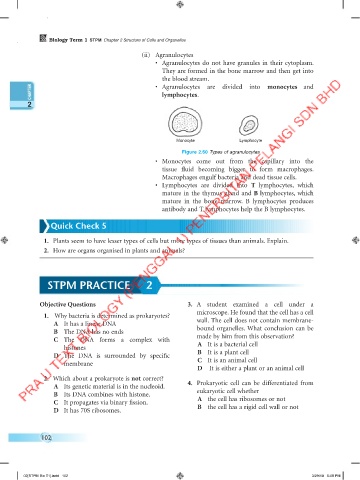
                                                     •  Agranulocytes  are  divided  into  monocytes  and
                                                       lymphocytes.
          2


                                                            Monocyte            Lymphocyte
                                                                 Figure 2.60 Types of agranulocytes
                                                     •  Monocytes  come  out  from  the  capillary  into  the
                                                       tissue  fluid  becoming  bigger  to form  macrophages.
                                                       Macrophages engulf bacteria and dead tissue cells.
                                                     •  Lymphocytes  are  divided  into  T  lymphocytes, which
                                                       mature in the thymus gland and B lymphocytes, which
                                                       mature in the bone marrow. B lymphocytes produces
                                                       antibody and T lymphocytes help the B lymphocytes.


                  Quick Check 5

                1.  Plants seem to have lesser types of cells but more types of tissues than animals. Explain.
                2.  How are organs organised in plants and animals?


                 STPM PRACTICE                   2


              Objective Questions                               3.  A student examined a cell under a
                                                                  microscope. He found that the cell has a cell
                1.   Why bacteria is determined as prokaryotes?
                   A   It has a linear DNA                        wall. The cell does not contain membrane-
                   B   The DNA has no ends                        bound organelles. What conclusion can be
                   C   The DNA forms a complex with               made by him from this observation?
                      histones                                    A  It is a bacterial cell
                   D  The DNA is surrounded by specific           B   It is a plant cell
                      membrane                                    C   It is an animal cell
                                                                  D   It is either a plant or an animal cell
                2.  Which about a prokaryote is not correct?
                   A  Its genetic material is in the nucleoid.    4.  Prokaryotic cell can be differentiated from
                   B  Its DNA combines with histone.              eukaryotic cell whether
                   C   It propagates via binary fission.          A   the cell has ribosomes or not
                   D  It has 70S ribosomes.                       B   the cell has a rigid cell wall or not


               102


         02[STPM Bio T1].indd   102                                                                     3/29/18   5:08 PM

