


Page 55 - PRE-U STPM BIOLOGY TERM 1
P. 55
Biology Term 1  STPM  Chapter 2 Structure of Cells and Organelles

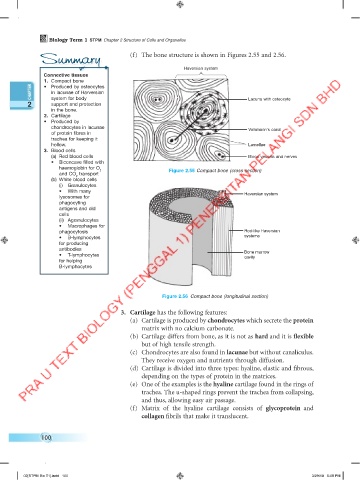
              Summary                       (f)  The bone structure is shown in Figures 2.55 and 2.56.

                                                              Haversian system
                Connective tissues
                1.  Compact bone
                •  Produced by osteocytes
                  in lacunae of Harversian
                  system for body                                                  Lacuna with osteocyte
          2       support and protection
                  in the bone.
                2.  Cartilage
                •  Produced by
                  chondrocytes in lacunae                                          Volkmann’s canal
                  of protein fibres in
                  trachea for keeping it
                  hollow.                                                          Lamellae
                3.  Blood cells
                  (a)  Red blood cells                                             Blood vessels and nerves
                  •  Biconcave filled with
                     haemoglobin for O                   Figure 2.55 Compact bone (cross section)
                                  2
                     and CO  transport
                          2
                  (b)  White blood cells
                     (i)  Granulocytes
                     •   With many                                                Haversian system
                     lysosomes for
                     phagocyting
                     antigens and old
                     cells
                     (ii)  Agranulocytes
                     •   Macrophages for
                     phagocytosis                                                 Rod-like Haversian
                     •   B-lymphocytes                                            systems
                     for producing
                     antibodies
                     •   T-lymphocytes                                            Bone marrow
                                                                                  cavity
                     for helping
                     B-lymphocytes


                                                       Figure 2.56  Compact bone (longitudinal section)

                                          3.   Cartilage has the following features:
                                            (a)  Cartilage is produced by chondrocytes which secrete the protein
                                                matrix with no calcium carbonate.
                                            (b)  Cartilage differs from bone, as it is not as hard and it is flexible
                                                but of high tensile strength.
                                            (c)  Chondrocytes are also found in lacunae but without canaliculus.
                                                They receive oxygen and nutrients through diffusion.
                                            (d)  Cartilage is divided into three types: hyaline, elastic and fibrous,
                                                depending on the types of protein in the matrices.
                                            (e)  One of the examples is the hyaline cartilage found in the rings of
                                                trachea. The u-shaped rings prevent the trachea from collapsing,
                                                and thus, allowing easy air passage.
                                            (f)  Matrix of the hyaline cartilage consists of  glycoprotein  and
                                                collagen fibrils that make it translucent.


               100


         02[STPM Bio T1].indd   100                                                                     3/29/18   5:08 PM

