


Page 54 - PRE-U STPM BIOLOGY TERM 1
P. 54
Biology Term 1  STPM  Chapter 2 Structure of Cells and Organelles

                     (c)  Smooth muscle
                         (i)  Smooth muscle is also known as involuntary muscle, as it
                             is not under our conscious control but it is controlled by
                             the autonomic nervous system.
                         (ii)  It is found in the alimentary canal, dermis, uterus, arteries
                             and trachea.
                         (iii)  It is arranged in  strands or layers. It is not branched or                   2
                             attached to the bone.
                         (iv)  It  is  made  up  of  individual  cells,  each  having  its  own
                             nucleus and plasma membrane.
                         (v)  It has no striations, as its myofibrils do not align themselves
                             with thick and thin filaments forming bands.
                         (vi)  It is supplied with nerves from the viseral motor neurone,
                             a part of the autonomic nervous system.
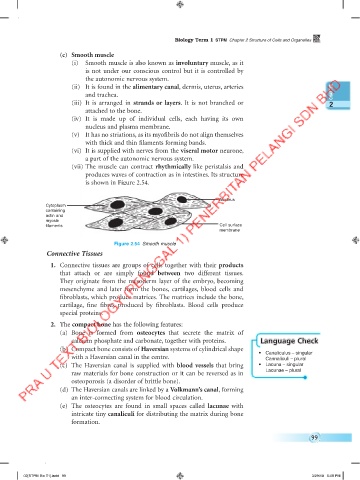
                         (vii) The muscle can contract rhythmically like peristalsis and
                             produces waves of contraction as in intestines. Its structure
                             is shown in Figure 2.54.


                                                                          Nucleus
                Cytoplasm
                containing
                actin and
                myosin
                filaments                                                 Cell surface
                                                                          membrane

                                       Figure 2.54  Smooth muscle
                Connective Tissues
                  1.   Connective tissues are groups of cells together with their products
                     that attach or are simply found  between two different tissues.
                     They originate from the mesoderm layer of the embryo, becoming    Language Check
                                                                                       Language Check
                     mesenchyme and later form the bones, cartilages, blood cells and
                     fibroblasts, which produce matrices. The matrices include the bone,
                     cartilage, fine fibres produced by fibroblasts. Blood cells produce
                     special proteins.
                  2.   The compact bone has the following features:
                     (a)  Bone is formed from  osteocytes  that secrete the matrix of
                                                                                       Language Check
                         calcium phosphate and carbonate, together with proteins.      Language Check
                     (b)  Compact bone consists of Haversian systems of cylindrical shape
                         with a Haversian canal in the centre.                         •  Canaliculus – singular
                                                                                         Cannaliculi – plural

                     (c)  The Haversian canal is supplied with  blood vessels that bring   •  Lacuna – singular
                         raw materials for bone construction or it can be reversed as in      Lacunae – plural
                         osteoporosis (a disorder of brittle bone).
                     (d)  The Haversian canals are linked by a Volkmann’s canal, forming
                         an inter-connecting system for blood circulation.
                     (e)  The osteocytes are found in small spaces called  lacunae  with
                         intricate tiny canaliculi for distributing the matrix during bone
                         formation.


                                                                                                        99


         02[STPM Bio T1].indd   99                                                                      3/29/18   5:08 PM

