Page 57 - PRE-U STPM CHEMISTRY TERM 1
P. 57
Chemistry Term 1  STPM
                     (ii)  Using the expression:                 (b)  The order of reaction with respect to a given substance
                               [H ] =  K C                           is the power to which the molar concentration of the
                                 +
                                      b
                           (7.9 × 10 )  = (1.8 × 10 )C               substance is raised in an experimentally determined
                                          –5
                                –4 2
                                 C = 3.5 × 10  mol dm –3             rate equation.
                                          –2
                         [CH COOH] = 3.5 × 10  mol dm –3         (c)  (i)  Rate = k[NO Cl]
                                          –2
                            3
                  (c)  CH COOH is a weak acid that dissociates partially in      (ii)  Mechanism:  2
                        3
                     water. As a result, more of it must be present to   NO Cl : NO  + Cl   Slow (Rate-determining
                     provide the same H  concentration.                    2      2     step)
                                   +
                  (d)  (i)  H9C≡C9H + NH  : H9C≡C  + NH 3
                                                 –
                                        –
                                       2
                     (ii)  In the above reaction, ethyne acts a proton   NO Cl + Cl : NO  + Cl   Fast
                                                                                         2
                                                                                      2
                                                                           2
                         donor (Bronsted-Lowry acid) while the NH 2 –     (iii)  During the reaction, the colour of the mixture
                         ion acts as a proton acceptor (Bronsted-Lowry   changes from yellow (NO Cl) to brown (NO ).
                                                                                                       2
                                                                                          2
                         base).                                 19  (a)  A buffer solution is a solution that resists changes in
                                                                     pH on the addition of a little acid or base.
                                                                                
                                                                                         –
                                                                                               +
              SECTION C                                          (b)  CH COOH(aq)  CH COO (aq) + H (aq)
                                                                       3
                                                                                    3
                                                                     CH COONa(aq) : CH COO (aq) + Na (aq)
                                                                                         –
                                                                                                 +
                18  (a)  (i)  Change in temperature:                   3             3
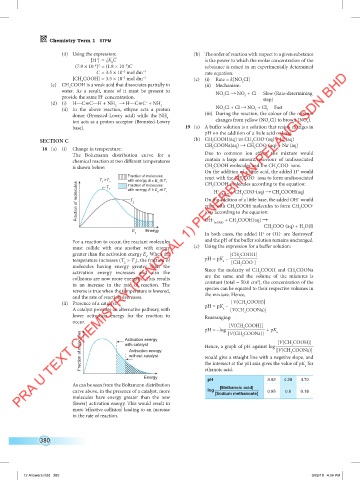
                         The Boltzmann distribution curve for a      Due to common ion effect, the mixture would
                         chemical reaction at two different temperatures   contain a large amount/resoviour of undissociated
                                                                                                 –
                         is shown below:                             CH COOH molecules and the CH COO  ions.
                                                                       3
                                                                                            3
                                                                     On the addition of a little acid, the added H  would
                                                                                                    +
                                           Fraction of molecules     react with the CH COO  ions to form undisoociated
                                                                                     –
                                  T >T 1 2  with energy, E ≥ E  at T 2  CH COOH molecules according to the equation:
                                                                                 3
                                   1
                                                     a
                           Fraction of molecules  T 2  a  1          On the addition of a little base, the added OH  would  –
                                           Fraction of molecules
                                                                       3
                                    T
                                           with energy, E ≥ E  at T
                                                                        H
                                                                              + CH COO (aq) : CH COOH(aq)
                                                                         +
                                                                                     –
                                                                                 3
                                                                                              3
                                                                          (added)
                                                                                                    –
                                                                     react with CH COOH molecules to form CH COO
                                                                               3
                                                                                                    3
                                                                     ions according to the equation:
                                                                     OH
                                                                       –
                                                                        (addad)  + CH COOH(aq) :
                                                                               3
                                                                                        CH COO (aq) + H O(l)
                                                                                               –
                                             E   Energy                                    3          2
                                                                                              –
                                                                                        +
                                              a                      In both cases, the added H  or OH  are ‘destroyed’
                         For a reaction to occur, the reactant molecules   and the pH of the buffer solution remains unchanged.
                         must collide with one another with energy   (c)  Using the expression for a buffer solution:
                         greater than the activation energy E . When the     [CH COOH]
                                                 a
                                                                                3
                         temperature increases (T  > T ), the fraction of      pH = pK  –   [CH COO ]
                                                                           a
                                                                                     –
                                          2
                                              1
                         molecules having energy greater than the                3
                         activation energy increases and also the      Since the molarity of CH COOH and CH COONa
                                                                                       3
                                                                                                   3
                         collisions are now more energetic. This results   are the same and the volume of the mixtures is
                                                                                      3
                         in an increase in the rate of reaction. The   constant (total = 50.0 cm ), the concentration of the
                         reverse is true when the temperature is lowered,   species can be equated to their respective volumes in
                         and the rate of reaction decreases.         the mixture. Hence,
                     (ii)  Presence of a catalyst:                   pH = pK  –   [V(CH COOH)]
                                                                                  3
                         A catalyst provides an alternative pathway, with   a  [V(CH COONa)]
                         lower activation energy for the reaction to   Rearranging:  3
                         occur.
                                                                             [V(CH COOH)]
                                                                                  3
                                                                     pH = –log   [V(CH COONa)]  + pK a
                            Fraction of molecules  with catalyst     Hence, a graph of pH against log  [V(CH COONa)]
                                                                                 3
                                          Activation energy
                                                                                             [V(CH COOH)]
                                                                                                  3
                                            Activation energy
                                                                                                 3
                                            without catalyst
                                                                     would give a straight line with a negetive slope, and
                                                                     the intersect at the pH axis gives the value of pK  for
                                                 Energy              ethanoic acid.                   a
                                                                      pH                  3.92  4.28  4.70
                         As can be seen from the Boltzmann distribution   [Methanoic acid]
                         curve above, in the presence of a catalyst, more   log  [Sodium methanoate]  0.95  0.6  0.18
                         molecules have energy greater than the new
                         (lower) activation energy. This would result in
                         more ‘effective collision’ leading to an increase
                         in the rate of reaction.
              380
         12 Answers.indd   380                                                                          3/26/18   4:06 PM
   52   53   54   55   56   57   58   59