


Page 53 - PRE-U STPM CHEMISTRY TERM 1
P. 53
Chemistry Term 1 STPM
–
2+
–
(ii) Ca(OH) (s) Ca (aq) + 2OH (aq) H + + CH CH COO (aq) : CH CH COOH(aq)
2 (added) 3 2 3 2
2+
– 2
K = [Ca ][OH ] When a little base is added to the mixture, the added
sp
2
–5
3
–
(iii) K = (0.023)(0.046) = 4.87 10 mol dm –9 OH would react with the undissociated
sp
–
–
(iv) Ammonia is a weak base. The [OH ] in aqueous CH CH COOH molecules to form CH COO ions.
3
3
2
ammonia is not sufficient to cause OH – (added) + CH COOH(aq) :
3
precipitation of calcium hydroxide. CH COO (aq) + H O(l)
–
2
3
2.33 × 10 –3
(v) No. of moles of Ca(OH) = As a result, the pH of the buffer solution remains
2 74.1 constant.
–5
= 3.14 10 mol (c) Using the expression for acidic buffer solutions:
Solubility of Ca(OH) = 0.023 mol dm –3 [Propanoic acid]
2
3.14 × 10 –5 pH = pK – log
a
Volume of water needed = [Sodium propanoate]
0.023 0.050
–3
= 1.36 10 dm 3 5.9 = 4.87 – log x
+
[RCOO ][H O ] –3
–
2 (a) (i) K = 3 x = 0.54 mol dm
a [RCOOH] ∴ Mass of sodium propanoate to be added to
(ii) Using: 500 cm propanoic acid
3
ABBBB
+
[H ] = K C 1
a = (0.54 × 74)g
ABBBBBBBBBBBB
–4
= (7.5 10 )(0.18) 2
–2
= 1.16 10 mol dm –3 = 20.0 g
pH = 1.94 4 (a) pK = –log K
a a
(b) (i) A solution whose pH does not change signifi- (b) C H B(OH) + 2H O C H B(OH) + H O +
–
5
6
2
3
3
5
6
2
cantly on the addition of a little acid or base. C H COOH + H O C H COO + H O +
–
–
(ii) H + + RCOO → RCOOH 6 5 2 –9 6 5 3
(1.59 × 10 )(0.12)
+
(added) (c) [H ] = ABBBBBBBBBBBBB
–
OH – + RCOOH → RCOO + H O –5 –3
(added) 2 = 1.38 10 mol dm
(iii) Using the formula: pH = 4.86
[Acid] (d) Lower. Because benzoic acid is a stronger acid than
pH = pK – log
a [Salt] phenylboronic acid.
0.18 (e) (i)
= 3.12 – log pH
0.35
= 3.41
(c) On addition of sodium salt which provides the
–
RCOO ions, the following equilibrium will shift to
the left: 8.8 X
–
RCOOH RCOO + H +
+
The [H ] concentration decreases causing the pH to 4.2 X
increase.
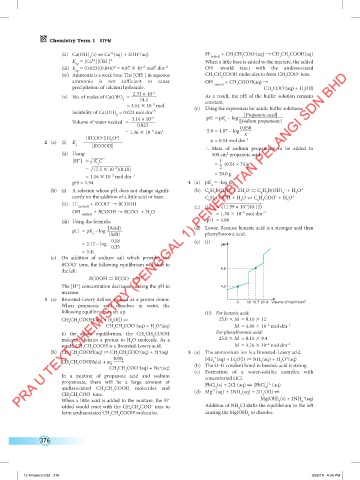
3 (a) Bronsted-Lowry defines an acid as a proton donor. 6 12 16.7 21.4 Volume of NaOH/cm 3
When propanoic acid dissolves in water, the
following equilibrium is set up. (ii) For benzoic acid:
CH CH COOH(aq) + H O(l) 25.0 M = 0.10 12
3 2 2
CH CH COO (aq) + H O (aq) M = 4.80 10 mol dm –3
+
–
–2
3 2 3
In the above equilibrium, the CH CH COOH For phenylboronic acid:
3
2
molecule donates a proton to H O molecule. As a 25.0 M = 0.10 9.4
2
–2
result, CH CH COOH is a Bronsted-Lowry acid. M = 3.76 10 mol dm
–3
2
3
(b) CH CH COOH(aq) CH CH COO (aq) + H (aq) 5 (a) The ammonium ion is a Bronsted-Lowry acid.
–
+
3 2 3 2
100% NH (aq) + H O(l) NH (aq) + H O (aq)
+
+
CH CH COONa(s) + aq 9: 4 2 3 3
3 2 (b) The O–H covalent bond in benzoic acid is strong.
+
–
CH CH COO (aq) + Na (aq)
3 2 (c) Formation of a water-soluble complex with
In a mixture of propanoic acid and sodium concentrated HCl.
propanoate, there will be a large amount of – 2–
undissociated CH CH COOH molecules and PbCl (s) + 2Cl (aq) [PbCl ] (aq)
2
4
3
2
2+
CH CH COO ions. (d) Mg (aq) + 2NH (aq) + 2H O(l)
–
3
2
3
+
2
When a little acid is added to the mixture, the H + Mg(OH) (s) + 2NH (aq)
4
2
added would react with the CH CH COO ions to Addition of NH Cl shifts the equilibrium to the left
–
4
2
3
form undissociated CH CH COOH molecules. causing the Mg(OH) to dissolve.
3 2 2
376
12 Answers.indd 376 3/26/18 4:06 PM

