


Page 12 - PRE-U STPM MATHEMATICS (T) TERM 1
P. 12
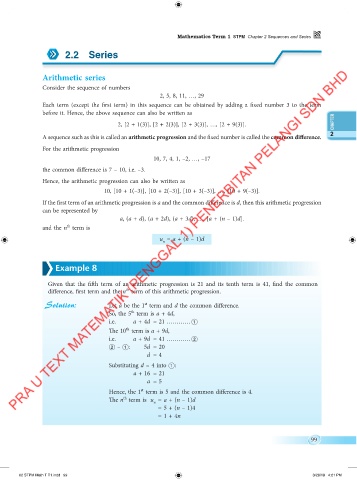
Mathematics Term 1 STPM Chapter 2 Sequences and Series
2.2 Series
Arithmetic series
Consider the sequence of numbers
2, 5, 8, 11, …, 29
Each term (except the first term) in this sequence can be obtained by adding a fixed number 3 to the term
before it. Hence, the above sequence can also be written as
2, [2 + 1(3)], [2 + 2(3)], [2 + 3(3)], …, [2 + 9(3)].
A sequence such as this is called an arithmetic progression and the fixed number is called the common difference. 2
For the arithmetic progression
10, 7, 4, 1, –2, …, –17
the common difference is 7 – 10, i.e. –3.
Hence, the arithmetic progression can also be written as
10, [10 + 1(–3)], [10 + 2(–3)], [10 + 3(–3)], …, [10 + 9(–3)].
If the first term of an arithmetic progression is a and the common difference is d, then this arithmetic progression
can be represented by
a, (a + d), (a + 2d), (a + 3d), …, [a + (n – 1)d].
th
and the n term is
u = a + (n – 1)d
n
Example 8
Given that the fifth term of an arithmetic progression is 21 and its tenth term is 41, find the common
th
difference, first term and the n term of this arithmetic progression.
Solution: Let a be the 1 term and d the common difference.
st
So, the 5 term is a + 4d,
th
i.e. a + 4d = 21 …………
th
The 10 term is a + 9d,
i.e. a + 9d = 41 …………
– : 5d = 20
d = 4
Substituting d = 4 into :
a + 16 = 21
a = 5
Hence, the 1 term is 5 and the common difference is 4.
st
th
The n term is u = a + (n – 1)d
n
= 5 + (n – 1)4
= 1 + 4n
99
02 STPM Math T T1.indd 99 3/28/18 4:21 PM

