


Page 25 - PRE-U STPM MATHEMATICS (T) TERM 1
P. 25
Mathematics Term 1 STPM Chapter 2 Sequences and Series
1
th
9. Find the sum to the n term of the geometric series 108 + 60 + 33 + … . If s is the smallest number
3
which exceeds this sum for all values of n, find the value of s. Find also the smallest value of n such that
the sum of the series exceeds 99% of the value of s.
10. Write down the first four terms of a geometric series with sum 4 and first term 1. Find the value of r
such that the series 3
2
r + r 2 + r 2 + …
2 2
1 + r 2 (1 + r )
is convergent, and also the non zero value of the sum.
2
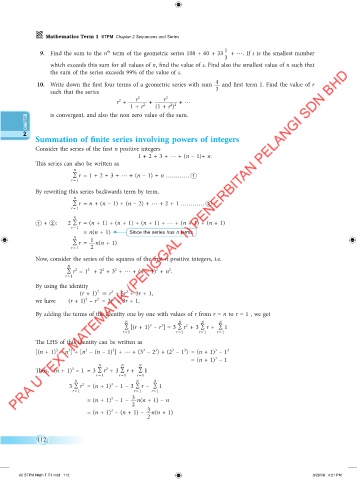
Summation of finite series involving powers of integers
Consider the series of the first n positive integers
1 + 2 + 3 + … + (n – 1)+ n.
This series can also be written as
n
∑ r = 1 + 2 + 3 + … + (n – 1) + n …………
r = 1
By rewriting this series backwards term by term,
n
∑ r = n + (n – 1) + (n – 2) + … + 2 + 1 …………
r = 1
n
+ : 2 ∑ r = (n + 1) + (n + 1) + (n + 1) + … + (n + 1) + (n + 1)
r = 1
= n(n + 1) Since the series has n terms
n
∑ r = 1 n(n + 1)
r = 1 2
Now, consider the series of the squares of the first n positive integers, i.e.
n
2
2
2
2
2
2
∑ r = 1 + 2 + 3 + … + (n – 1) + n .
r = 1
By using the identity
(r + 1) r + 3r + 3r + 1,
3
2
3
3
2
we have (r + 1) – r = 3r + 3r + 1.
3
By adding the terms of the identity one by one with values of r from r = n to r = 1 , we get
n n n n
∑ [(r + 1) – r ] = 3 ∑ r + 3 ∑ r + ∑ 1
3
3
2
r = 1 r = 1 r = 1 r = 1
The LHS of this identity can be written as
3
3
3
3
3
3
[(n + 1) – n ] + [n – (n – 1) ] + … + (3 – 2 ) + (2 – 1 ) = (n + 1) – 1 3
3
3
3
3
= (n + 1) – 1
n n n
Thus, (n + 1) – 1 = 3 ∑ r + 3 ∑ r + ∑ 1
3
2
r = 1 r = 1 r = 1
n n n
3
2
3 ∑ r = (n + 1) – 1 – 3 ∑ r – ∑ 1
r = 1 r = 1 r = 1
3
= (n + 1) – 1 – 3 n(n + 1) – n
2
= (n + 1) – (n + 1) – 3 n(n + 1)
3
2
112
02 STPM Math T T1.indd 112 3/28/18 4:21 PM

