Page 34 - PRE-U STPM MATHEMATICS (T) TERM 1
P. 34
Mathematics Term 1  STPM  Chapter 2 Sequences and Series
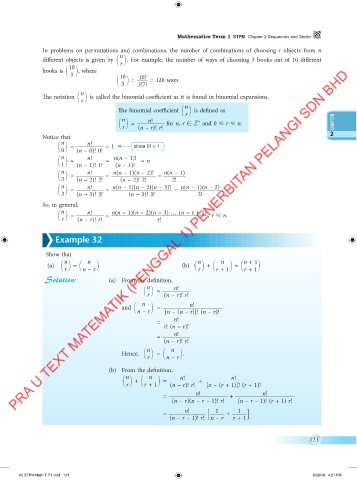
               In problems on permutations and combinations, the number of combinations of choosing  r objects from  n
                                        n
               different  objects is  given  by   1 2 . For  example, the number  of ways  of choosing  3 books  out of  10 different
                                        r
                       10
               books is  1 2 , where
                        3
                                        10
                                              10!
                                       1 2  =  3!7!  = 120 ways
                                        3
                           n
               The notation  1 2  is called the binomial coefficient as it is found in binomial expansions.
                           r
                                                             n
                                       The binomial coefficient  1 2  is defined as
                                                             r
                                         n
                                                 n!
                                        1 2  =   (n – r)! r!  for n, r  Z  and 0  r  n.
                                                                 +
                                         r
               Notice that                                                                                  2
                     n
                             n!
                    1 2  =   (n – 0)! 0!  = 1   since 0! = 1
                     0
                     n
                             n!
                    1 2  =   (n – 1)! 1!  =   n(n – 1)!   = n
                     1
                                       (n – 1)!
                     n
                             n!
                    1 2  =   (n – 2)! 2!  =   n(n – 1)(n – 2)!   =  n(n – 1)
                     2
                                                         2!
                                        (n – 2)! 2!
                     n
                             n!
                    1 2  =   (n – 3)! 3!  =   n(n – 1)(n – 2)(n – 3)!  =  n(n – 1)(n – 2)
                                                                 3!
                                           (n – 3)! 3!
                     3
               So, in general,
                     n
                             n!
                    1 2  =   (n – r)! r!   =  n(n – 1)(n – 2)(n – 3) … (n – r + 1)  , r  n.
                     r
                                                    r!
                   Example 32
                Show that
                      n
                             n
                                                                         n
                                                                 n
                         =
                (a)   1 2 1 n – r 2                         (b)  1 2 1 r + 1 2 1 n + 1 2
                                                                     +
                                                                              =
                                                                 r
                      r
                                                                                r + 1
                Solution:           (a)  From the definition,
                                                 n
                                                          n!
                                                1 2   =   (n – r)! r!
                                                 r
                                               n
                                                               n!
                                         and  1 n – r 2   =   [n – (n – r)]! (n – r)!
                                                     =    n!
                                                      r! (n – r)!
                                                     =    n!
                                                      (n – r)! r!
                                                 n
                                                         n
                                         Hence,   1 2   =  1 n – r 2 .
                                                 r
                                    (b)  From the definition,
                                          n
                                                 n
                                                            n!
                                                                            n!
                                             +
                                           1 2 1 r + 1 2   =   (n – r)! r!  +   [n – (r + 1)]! (r + 1)!
                                          r
                                                       =         n!         +         n!
                                                         (n – r)(n – r – 1)! r!  (n – r – 1)! (r + 1) r!
                                                       =     n!       3  1   +   1  4
                                                        (n – r – 1)! r! n – r  r + 1
                                                                                                      121
       02 STPM Math T T1.indd   121                                                                    3/28/18   4:21 PM
   29   30   31   32   33   34   35   36   37   38   39