


Page 6 - PRE-U STPM MATHEMATICS (T) TERM 1
P. 6
Mathematics Term 1 STPM Chapter 2 Sequences and Series
2.1 Sequences
Sequences
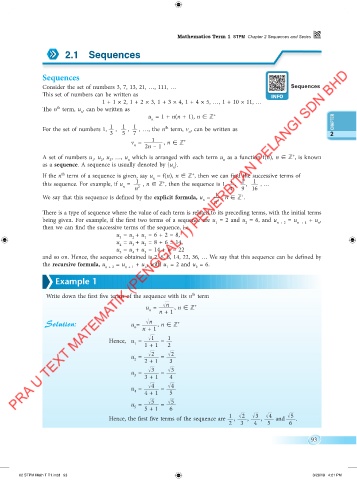
Consider the set of numbers 3, 7, 13, 21, …, 111, … Sequences
This set of numbers can be written as INFO
1 + 1 × 2, 1 + 2 × 3, 1 + 3 × 4, 1 + 4 × 5, …, 1 + 10 × 11, …
th
The n term, u , can be written as
n
u = 1 + n(n + 1), n Z +
n
For the set of numbers 1, — , — , — , …, the n term, v , can be written as
1 1 1
th
3 5 7 n 2
1
v = 2n – 1 , n Z +
n
+
A set of numbers u , u , u , …, u which is arranged with each term u as a function f(n), n Z , is known
1
n
3
2
n
as a sequence. A sequence is usually denoted by {u }.
n
If the n term of a sequence is given, say u = f(n), n Z , then we can find the successive terms of
th
+
n
this sequence. For example, if u = — , n Z , then the sequence is 1, — , — , — , …
1
1 1 1
+
n n 4 9 16
2
1
We say that this sequence is defined by the explicit formula, u = — , n Z .
+
n n 2
There is a type of sequence where the value of each term is related to its preceding terms, with the initial terms
being given. For example, if the first two terms of a sequence are u = 2 and u = 6, and u n + 2 = u + u ,
n
1
2
n + 1
then we can find the successive terms of the sequence, i.e.
u = u + u = 6 + 2 = 8,
1
3
2
u = u + u = 8 + 6 = 14,
2
3
4
u = u + u = 14 + 8 = 22
4
5
3
and so on. Hence, the sequence obtained is 2, 6, 8, 14, 22, 36, … We say that this sequence can be defined by
the recursive formula, u n + 2 = u n + 1 + u , with u = 2 and u = 6.
2
1
n
Example 1
th
Write down the first five terms of the sequence with its n term
n
u = n + 1 , n Z +
n
n
Solution: u = n + 1 , n Z +
n
1
Hence, u = 1 + 1 = 1
2
1
2
u = 2 + 1 = 3 2
2
3
u = 3 + 1 = 4 3
3
4
u = 4 + 1 = 5 4
4
5
u = 5 + 1 = 6 5
5
Hence, the first five terms of the sequence are 1 , 2 , 3 , 4 and 5 .
2 3 4 5 6
93
02 STPM Math T T1.indd 93 3/28/18 4:21 PM

