


Page 22 - Focus TG4 KSSM (Physics) Terbitan Penerbitan Pelangi Sdn Bhd
P. 22
Physics  Form 4  Chapter 2 Force and Motion I

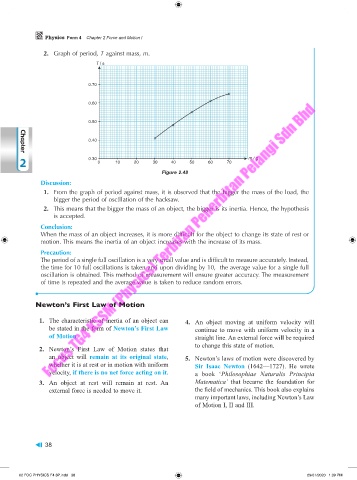
                2.  Graph of period, T against mass, m.
                                T / s


                              0.70


                              0.60

                              0.50


                              0.40

        Chapter
       2                      0.30  0  10    20    30    40    50    60    70     m / g
                                                      Figure 2.48
              Discussion:
                1.  From the graph of period against mass, it is observed that the bigger the mass of the load, the
                  bigger the period of oscillation of the hacksaw.
                2.  This means that the bigger the mass of an object, the bigger is its inertia. Hence, the hypothesis
                  is accepted.
              Conclusion:
              When the mass of an object increases, it is more difficult for the object to change its state of rest or
              motion. This means the inertia of an object increases with the increase of its mass.
              Precaution:
              The period of a single full oscillation is a very small value and is difficult to measure accurately. Instead,
              the time for 10 full oscillations is taken and upon dividing by 10,  the average value for a single full
              oscillation is obtained. This method of measurement will ensure greater accuracy. The measurement
              of time is repeated and the average value is taken to reduce random errors.


             Newton’s First Law of Motion

               1.  The characteristic of inertia of an object can     4.  An object moving at uniform velocity  will
                 be stated in the form of Newton’s First Law    continue to move with uniform velocity in a
                 of Motion.                                     straight line. An external force will be required
                                                                to change this state of motion.
               2.  Newton’s First Law of Motion states that
                 an object will  remain at its original state,     5.  Newton’s laws of motion were discovered by
                 whether it is at rest or in motion with uniform   Sir Isaac Newton (1642—1727). He wrote
                 velocity, if there is no net force acting on it.  a book ‘Philosophiae Naturalis Principia
               3.  An object at rest  will remain at  rest.  An   Matematica’  that  became  the  foundation  for
                 external force is needed to move it.           the field of mechanics. This book also explains
                                                                many important laws, including Newton’s Law
                                                                of Motion I, II and III.


                38


       02 FOC PHYSICS F4 3P.indd   38                                                                29/01/2020   1:39 PM

