


Page 24 - Focus TG4 KSSM (Physics) Terbitan Penerbitan Pelangi Sdn Bhd
P. 24
Physics  Form 4  Chapter 2 Force and Motion I

                               SPM Tips                           Checkpoint                   2.4
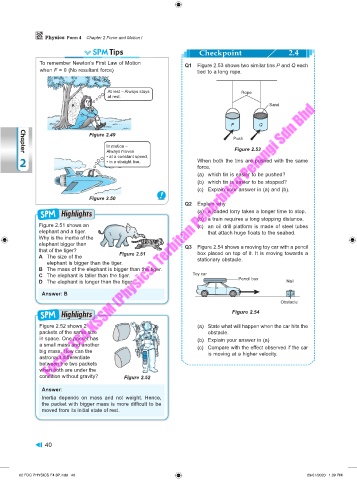
              To remember Newton’s First Law of Motion        Q1  Figure 2.53 shows two similar tins P and Q each
              when F = 0 (No resultant force)                    tied to a long rope.


                                    At rest – Always stays                      Rope
                                    at rest.
                                                                                         Sand


                                                                            P        Q
                              Figure 2.49
                                                                             Push
                                    In motion –                              Figure 2.53
                                    Always moves
        Chapter
                                    • at a constant speed,
       2                            • in a straight line.         When both the tins are pushed with the same
                                                                 force,
                                                                 (a)  which tin is easier to be pushed?
                                                                 (b)  which tin is easier to be stopped?
                                                                 (c)  Explain your answer in (a) and (b).
                              Figure 2.50
                                                              Q2  Explain why
              SPM    Highlights                                  (a)  a loaded lorry takes a longer time to stop.
                                                                 (b)  a train requires a long stopping distance.
              Figure 2.51 shows an                               (c)  an oil drill platform is made of steel tubes
              elephant and a tiger.                                  that attach huge floats to the seabed.
              Why is the inertia of the
              elephant bigger than                            Q3  Figure 2.54 shows a moving toy car with a pencil
              that of the tiger?                                 box placed on top of it. It is moving towards a
              A  The size of the        Figure 2.51              stationary obstacle.
                elephant is bigger than the tiger.
              B  The mass of the elephant is bigger than the tiger.
              C  The elephant is taller than the tiger.         Toy car
              D  The elephant is longer than the tiger.                        Pencil box     Nail

               Answer: B
                                                                                            Obstacle
              SPM    Highlights                                             Figure 2.54

              Figure 2.52 shows 2                                (a)  State what will happen when the car hits the
              packets of the same size                               obstacle.
              in space. One packet has                           (b)  Explain your answer in (a)
              a small mass and another                           (c)  Compare with the effect observed if the car
              big mass. How can the                                  is moving at a higher velocity.
              astronaut differentiate
              between the two packets
              when both are under the
              condition without gravity?   Figure 2.52
               Answer:
               Inertia depends  on mass and not weight. Hence,
               the packet with bigger mass is more difficult to be
               moved from its initial state of rest.


                40
                40


       02 FOC PHYSICS F4 3P.indd   40                                                                29/01/2020   1:39 PM

