


Page 21 - Focus TG4 KSSM (Physics) Terbitan Penerbitan Pelangi Sdn Bhd
P. 21
Physics  Form 4  Chapter 2 Force and Motion I

                  Eksperimen 2.1
                  Experiment 2.1
                  Eksperimen 2.1
                 Problem statement: What is the relationship between mass and inertia?
                 Aim: To investigate the relationship between inertia and mass.

                 Inference: The inertia of an object is influenced by its mass.
                 Hypothesis: The inertia of a body increases when its mass increases.
                 Variables:
                 (a)  Manipulated variable :  Mass
                 (b)  Responding variable  :  Inertia
                 (c)  Fixed variable   :  Type of hacksaw blade
                 Operational Definition:                                                                     Chapter
                 Period of oscillation is an indicator for inertia, the responding variable. The bigger the period of
                 oscillation, the bigger the inertia.                                                       2
                 Apparatus and material: Hacksaw blade, G-clamp, stopwatch, and plasticine
                 Procedure:
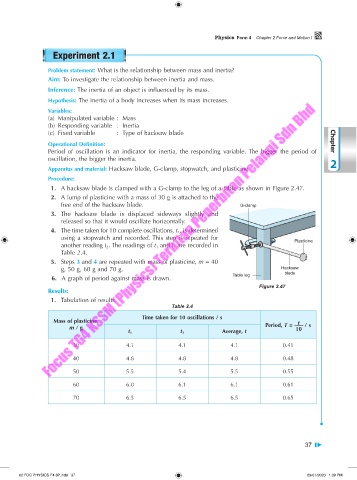
                   1.  A hacksaw blade is clamped with a G-clamp to the leg of a table as shown in Figure 2.47.
                   2.  A lump of plasticine with a mass of 30 g is attached to the
                     free end of the hacksaw blade.                            G-clamp
                   3.  The hacksaw blade is displaced sideways slightly and
                     released so that it would oscillate horizontally.
                   4.  The time taken for 10 complete oscillations, t 1 , is determined
                     using a stopwatch and recorded. This step is repeated for                   Plasticine
                     another reading t 2 . The readings of t 1  and t 2  are recorded in
                     Table 2.4.
                   5.  Steps 3 and 4 are repeated with mass of plasticine, m = 40
                     g, 50 g, 60 g and 70 g.                                                Hacksaw
                                                                             Table leg        blade
                   6.  A graph of period against mass is drawn.
                                                                                     Figure 2.47
                 Results:
                   1.  Tabulation of results.
                                                         Table 2.4
                                               Time taken for 10 oscillations / s
                  Mass of plasticine,                                                             t
                        m / g                                                          Period, T =   10   / s
                                           t 1              t 2          Average, t
                         30               4.1              4.1              4.1              0.41

                         40               4.8              4.8              4.8              0.48

                         50               5.5              5.4              5.5              0.55
                         60               6.0              6.1              6.1              0.61

                         70               6.5              6.5              6.5              0.65


                                                                                                    37


       02 FOC PHYSICS F4 3P.indd   37                                                                29/01/2020   1:39 PM

