


Page 18 - Focus TG4 KSSM (Physics) Terbitan Penerbitan Pelangi Sdn Bhd
P. 18
Physics  Form 4  Chapter 2 Force and Motion I

                    ACTIVITY 2.2

              Aim:  To determine the value of gravitational
                    acceleration                                  Diameter = d cm            Steel  ball
              Apparatus and Materials:                                                        Photogate A
              Photogate kit and electronic timer, steel ball,   Time passing through
              micrometer screw gauge                         photogate A   = t  s
                                                                            1
              Instructions:
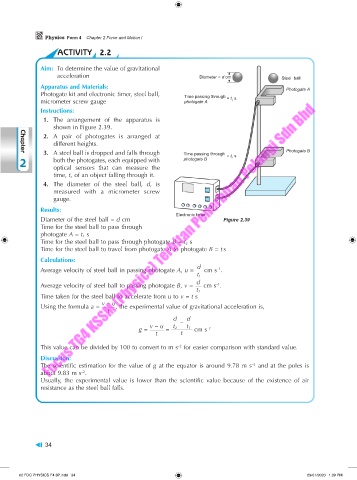
                1.  The arrangement of the apparatus is
                  shown in Figure 2.39.
                2.  A pair of photogates is arranged at
                  different heights.
                3.  A steel ball is dropped and falls through   Time passing through  = t  s  Photogate B
        Chapter
       2          both the photogates, each equipped with    photogate B    2
                  optical sensors that can measure the
                  time, t, of an object falling through it.
                4.  The diameter of the steel ball,  d, is
                  measured with a micrometer screw
                  gauge.
              Results:
                                                          Electronic timer
              Diameter of the steel ball = d cm                           Figure 2.39
              Time for the steel ball to pass through
              photogate A = t 1  s
              Time for the steel ball to pass through photogate B = t 2  s
              Time for the steel ball to travel from photogate A to photogate B = t   s
              Calculations:
                                                                 d
              Average velocity of steel ball in passing photogate A, u =    cm s .
                                                                        –1
                                                                 t 1
                                                                 d
              Average velocity of steel ball to passing photogate B, v =    cm s .
                                                                       –1
                                                                 t 2
              Time taken for the steel ball to accelerate from u to v = t s
                                  v – u
              Using the formula a =    , the experimental value of gravitational acceleration is,
                                    t
                                                         d   –   d
                                                  v – u
                                              g =      =   t 2  t 1   cm s –2
                                                    t       t
                                                           –2
              This value can be divided by 100 to convert to m s  for easier comparison with standard value.
              Discussion:
              The scientific estimation for the value of g at the equator is around 9.78 m s  and at the poles is
                                                                                   –2
              about 9.83 m s .
                           –2
              Usually,  the  experimental  value  is  lower  than  the  scientific  value  because  of  the  existence  of  air
              resistance as the steel ball falls.


                34


       02 FOC PHYSICS F4 3P.indd   34                                                                29/01/2020   1:39 PM

