


Page 29 - Focus TG4 KSSM (Physics) Terbitan Penerbitan Pelangi Sdn Bhd
P. 29
Physics  Form 4  Chapter 2 Force and Motion I

                                                                Solution
               EXAMPLE 2.16
                                                                Total momentum before coupling
                A lorry with a mass of 8 000 kg moves with a    = (2.5 × 10  × 10) + (2.5 × 10  × 0.8)
                                                                                        4
                                                                         4
                velocity of 30 m s  . The lorry then collides with   = 4.5 × 10  kg m s –1
                                –1
                                                                        4
                a car with a mass of 1500 kg and travelling with   Total momentum after coupling
                a velocity of 20 m s . After the collision, the two   = 5.0 × 10  × v
                                 –1
                                                                        4
                vehicles stick and move together with a velocity v.
                Determine the value of v.                       According  to  the  principle  of  conservation  of
                                                                momentum,
                Solution                                        Total momentum     Total momentum

                                  30 m s –1    20 m s –1        before coupling     =  after coupling
                                                                 5.0 × 10  × v  = 4.5 × 10  kg m s –1
                                                                                    4
                                                                       4
                                                                         v  = 0.9 m s –1                     Chapter
                Momentum of lorry before collision              Assumption: The sum of the external forces acting
                = 8 000 × 30                                    on the system consisting of the two boxcars is zero.
                = 240 000 kg m s –1                                                                         2
                Momentum of car before collision              Note:
                = 1 500 × 20                                    1.  For experiments in this chapter, a  friction
                = 30 000 kg m s –1                                 compensated inclined plane is used.
                    Total momentum  =   Total momentum                                         Friction
                      before collision    after collision
                                                                  Component of
                    240 000 + 30 000  =  (8 000+1 500)v           weight of the
                                                                  trolley
                    270 000 kg m s –1   =  9 500v
                                     270 000                         Weight component cancels the effect of friction
                Therefore,       v  =   9 500
                                    = 28 m s –1                                 Figure 2.63
                                                                2.  A friction compensated inclined plane has an
                                                                   inclination in such a way that is the friction on
                                                                   the surface of the inclined plane is balanced
               EXAMPLE 2.17                                        out by the component of the weight along the
                                                                   trolley.
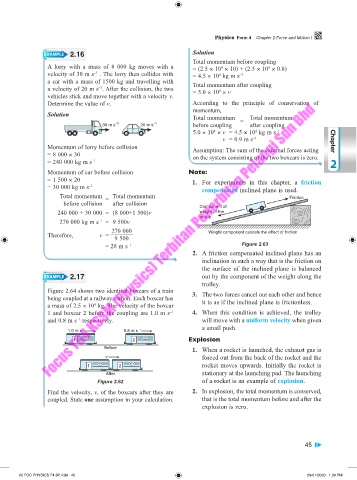
                Figure 2.64 shows two identical boxcars of a train     3.  The two forces cancel out each other and hence
                being coupled at a railway station. Each boxcar has
                a mass of 2.5 × 10  kg. The velocity of the boxcar     it is as if the inclined plane is frictionless.
                                4
                1 and boxcar 2 before the coupling are 1.0 m s      4.  When  this condition  is achieved,  the  trolley
                                                        –1
                and 0.8 m s  respectively.                         will move with a uniform velocity when given
                          –1
                                                                   a small push.
                       1.0 m s –1        0.8 m s –1
                         1                  2                 Explosion
                                   Before                       1.  When a rocket is launched, the exhaust gas is
                                   v                               forced out from the back of the rocket and the
                             1          2                          rocket moves upwards. Initially the rocket is
                                   After                           stationary at the launching pad. The launching
                                 Figure 2.62                       of a rocket is an example of explosion.
                Find the velocity, v, of the boxcars after they are     2.  In explosion, the total momentum is conserved,
                coupled. State one assumption in your calculation.   that is the total momentum before and after the
                                                                   explosion is zero.


                                                                                                    45


       02 FOC PHYSICS F4 3P.indd   45                                                                29/01/2020   1:39 PM

