


Page 4 - Focus TG4 KSSM (Physics) Terbitan Penerbitan Pelangi Sdn Bhd
P. 4
Physics  Form 4  Chapter 2 Force and Motion I
                                                              2.  Non-linear motion is motion that is not in a
              2.1   Linear Motion                                straight line.

                                                              3.  When analysing linear and non-linear motion,
                 My motion is a                                  distance, displacement, speed, velocity,
                 linear motion      My motion is a
                                    non-linear motion  Start     acceleration  and deceleration  are commonly
               Start          End     End     Not a straight line  encountered physical quantities.
                    A straight line                                            SPM Tips
                              Figure 2.1
                                                              Speed (scalar quantity)—magnitude only
               1.  Linear motion is a motion in a straight line.  Velocity (vector quantity)—magnitude and direction


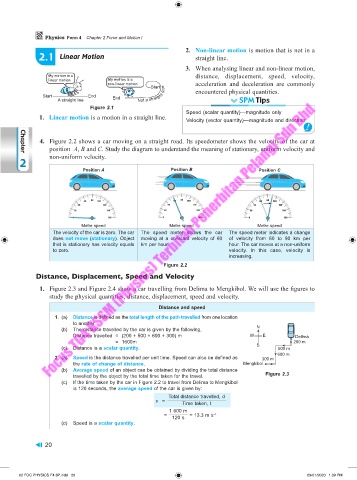
               4.  Figure 2.2 shows a car moving on a straight road. Its speedometer shows the velocity of the car at
                 position  A, B and C. Study the diagram to understand the meaning of stationary, uniform velocity and
                 non-uniform velocity.
        Chapter
       2
                           Kedudukan A                  Kedudukan B                 Kedudukan C
                                                         Position B
                            Position A
                                                                                     Position C


                            Metre speed                 Metre speed                  Metre speed
                  The velocity of the car is zero. The car   The speed meter shows the car   The speed meter indicates a change
                  does not move (stationary). Object   moving  at a constant velocity  of 60   of velocity from 60 to 90 km per
                  that is stationary has velocity equals   km per hour.    hour. The car moves at a non-uniform
                  to zero.                                                 velocity.  In  this  case,  velocity  is
                                                                           increasing.
                                                      Figure 2.2

             Distance, Displacement, Speed and Velocity
               1.  Figure 2.3 and Figure 2.4 show a car travelling from Delima to Mengkibol. We will use the figures to
                 study the physical quantities, distance, displacement, speed and velocity.

                                                     Distance and speed
                   1.  (a)  Distance is defined as the total length of the path travelled from one location
                         to another.
                      (b)  The distance travelled by the car is given by the following,  N
                         Distance travelled  =  (200 + 500 + 600 + 300) m         W   E          Delima
                                       =  1600m                                                 200 m
                      (c)  Distance is a scalar quantity.                            S     500 m
                                                                                           600 m
                   2.  (a)  Speed is the distance travelled per unit time. Speed can also be defined as   300 m
                         the rate of change of distance.                        Mengkibol
                         (b)  Average speed of an object can be obtained by dividing the total distance
                         travelled by the object by the total time taken for the travel.  Figure 2.3
                       (c)  If the time taken by the car in Figure 2.2 to travel from Delima to Mengkibol
                         is 120 seconds, the average speed of the car is given by:
                                                        Total distance travelled, d
                                                    v  =    Time taken, t

                                                        1 600 m
                                                      =   120 s   = 13.3 m s –1
                       (d)  Speed is a scalar quantity.


                20


       02 FOC PHYSICS F4 3P.indd   20                                                                29/01/2020   1:39 PM

