


Page 27 - ACE YR IGCSE A TOP APPROACH TO CHEM
P. 27
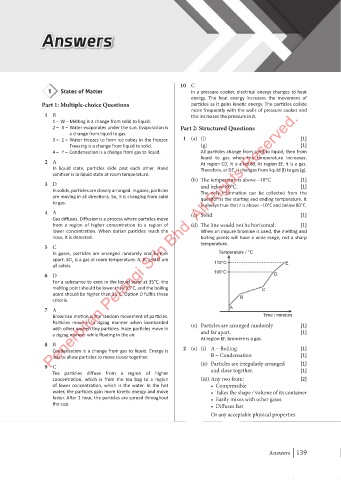
Answers


                                                                        10  C
                       1    States of Matter                              In a pressure cooker, electrical energy changes to heat
                                                                          energy.  The  heat  energy  increases  the  movement  of
                     Part 1: Multiple-choice Questions                    particles as it gains kinetic energy. The particles collide
                                                                          more frequently with the walls of pressure cooker and
                       9  C Penerbitan Pelangi Sdn Bhd. All Rights Reserved.
                       1  B                                               this increases the pressure in it.
                         1 – W – Melting is a change from solid to liquid.
                         2 –  X – Water evaporates under the sun. Evaporation is   Part 2: Structured Questions
                               a change from liquid to gas.
                         3 –  Z – Water freezes to form ice cubes in the freezer.     1  (a)  (l)               [1]
                               Freezing is a change from liquid to solid.       (g)                             [1]
                         4 –  Y – Condensation is a change from gas to liquid.  All particles change from solid to liquid, then from
                                                                             liquid  to  gas  when  the  temperature  increases.
                       2  A                                                  At region CD, it is a liquid. At region EF, it is a gas.
                         In  liquid  state,  particles  slide  past  each  other.  Hand   Therefore, at DE, it changes from liquid (l) to gas (g).
                         sanitiser is in liquid state at room temperature.
                                                                          (b)  The temperaure is above –10°C    [1]
                       3  D                                                  and below 80°C.                    [1]
                         In solids, particles are closely arranged. In gases, particles   The  only  information  can  be  collected  from  the
                         are moving in all directions. So, it is changing from solid   question is the starting and ending temperature. It
                         to gas.                                             is always true that t is above –10°C and below 80°C.
                       4  A                                               (c)  Solid                            [1]
                         Gas diffuses. Diffusion is a process where particles move
                         from  a  region  of  higher  concentration  to  a  region  of       (d)  The line would not be horizontal.   [1]
                         lower  concentration.  When  durian  particles  reach  the   When an impure bromine is used, the melting and
                         nose, it is detected.                               boiling points will have a wide range, not a sharp
                                                                             temperature.
                       5  C
                         In  gases,  particles  are  arranged  randomly  and  further   Temperature / °C
                         apart. SO  is a gas at room temperature. A, B, and D are
                                2
                         all solids.                                              110°C                    E
                                                                                  100°C
                       6  D                                                                            D
                         For a substance to exist in the liquid state at 35°C, the
                         melting point should be lower than 35°C, and the boiling                  C
                         point should be higher than 35°C. Option D fulfils these
                         criteria.                                                         B
                       7  A                                                            A
                         Brownian motion is the random movement of particles.                      Time / minutes
                         Particles  move  in  a  zigzag  manner  when  bombarded
                         with other unseen tiny particles. Haze particles move in       (e)  Particles are arranged randomly   [1]
                         a zigzag manner while floating in the air.          and far apart.                     [1]
                                                                             At region EF, bromine is a gas.
                       8  B
                         Condensation is a change from gas to liquid. Energy is     2  (a)  (i)  A – Boiling    [1]
                         lost to allow particles to move closer together.            B – Condensation           [1]
                                                                             (ii)  Particles are irregularly arranged   [1]
                                                                                 and close together.            [1]
                         Tea  particles  diffuse  from  a  region  of  higher
                         concentration,  which  is  from  the  tea  bag  to  a  region          (iii) Any two from:   [2]
                         of lower concentration, which is the water. In the hot             •  Compressible
                         water, the particles gain more kinetic energy and move             •  Takes the shape / volume of its container
                         faster. After 1 hour, the particles are spread throughout             •  Easily mixes with other gases
                         the cup.                                                •  Diffuses fast
                                                                                 Or any acceptable physical properties


                                                                                                     Answers    139


         Answers.indd   139                                                                                         3/4/22   3:54 PM

