


Page 31 - ACE YR IGCSE A TOP APPROACH TO CHEM
P. 31
(c)  Blow carbon dioxide into limewater   [1]
                            turn cloudy                        [1]                    O
                            Limewater  is  calcium  hydroxide.  When  carbon
                            dioxide  reacts  with  calcium  hydroxide,  calcium   O   Si     O
                            carbonate  is  formed.  Calcium  carbonate  is  a
                            precipitate that turns the solution cloudy.               O
                         (d)  Carbon dioxide:
                            •  Simple covalent compound                 5  (a)   +  +  –  +  +  –  +  –  +
                                                                                   –
                            •   Intermolecular forces / van der Waals forces   – –  + –  +  –  + –  –  +  –  +  –  +
                                                                                           –
                              are weak.                                       +  – +  –  +  –  +  –  +  – +  –
                                                                                   –
                                                                                         –
                                                                                               –
                            •  Less energy to overcome.                       –  + –  +  –  +  –  +  + –  –  +
                        Penerbitan Pelangi Sdn Bhd. All Rights Reserved.
                            Copper(II) oxide:                                    –      –  –
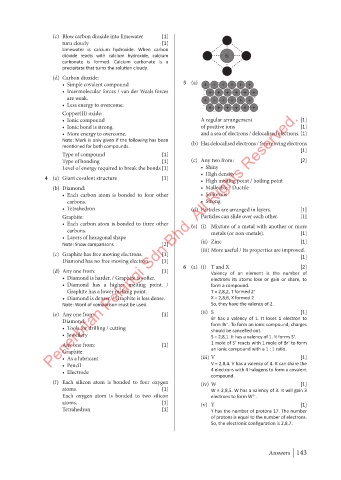
                            •  Ionic compound                                A regular arrangement              [1]
                            •  Ionic bond is strong.                         of positive ions                   [1]
                            •  More energy to overcome.                      and a sea of electrons / delocalised electrons. [1]
                            Note: Mark is only given if the following has been
                            mentioned for both compounds.                 (b)  Has delocalised electrons / free moving electrons
                            Type of compound                   [1]                                              [1]
                            Type of bonding                    [1]        (c)  Any two from:                    [2]
                            Level of energy required to break the bonds [1]         •  Shiny
                                                                             •  High density
                       4  (a)  Giant covalent structure        [1]           •  High melting point / boiling point
                         (b)  Diamond:                                       •  Malleable / Ductile
                            •   Each  carbon  atom  is  bonded  to  four  other          •  Sonorous
                              carbons.                                       •  Strong
                            •   Tetrahedron                               (d)  Particles are arranged in layers.   [1]
                            Graphite:                                        Particles can slide over each other.   [1]
                            •   Each carbon atom is bonded to three other       (e)  (i)  Mixture of a metal with another or more
                              carbons.                                           metals (or non-metals).        [1]
                            •   Layers of hexagonal shape
                            Note: Show comparisons             [2]           (ii)  Zinc                         [1]
                                                                             (iii) More useful / Its properties are improved.
                         (c)  Graphite has free moving electrons.   [1]                                         [1]
                            Diamond has no free moving electron.   [1]
                                                                        6  (a)  (i)  T and X                    [2]
                         (d)  Any one from:                    [1]               Valency  of  an  element  is  the  number  of
                            •   Diamond is harder. / Graphite is softer.         electrons  its  atoms  lose  or  gain  or  share,  to
                            •   Diamond  has  a  higher  melting  point.  /      form a compound.
                              Graphite has a lower melting point.                T = 2,8,2, T formed 2 +
                            •   Diamond is denser. / Graphite is less dense.     X = 2,8,6, X formed 2 –
                            Note: Word of comparison must be used.               So, they have the valency of 2.
                         (e)  Any one from:                    [1]           (ii)  S                            [1]
                            Diamond:                                             Br  has  a  valency  of  1.  It  loses  1  electron  to
                                                                                 form Br . To form an ionic compound, charges
                                                                                      –
                            •  Tools for drilling / cutting                      should be cancelled out.
                            •  Jewellery                                         S = 2,8,1. It has a valency of 1. It forms S .
                                                                                                              +
                                                                                         +
                                                                                                            –
                            Any one from:                      [1]               1 mole of S  reacts with 1 mole of Br  to form
                            Graphite:                                            an ionic compound with a 1 : 1 ratio.
                            •  As a lubricant                                (iii) V                            [1]
                            •  Pencil                                            V = 2,8,4. V has a valency of 4. It can share the
                            •  Electrode                                         4 electrons with 4 halogens to form a covalent
                                                                                 compound.
                         (f)  Each  silicon  atom  is  bonded  to  four  oxygen          (iv)  W                [1]
                            atoms.                             [1]               W = 2,8,5. W has a valency of 3. It will gain 3
                            Each  oxygen  atom  is  bonded  to  two  silicon     electrons to form W .
                                                                                               3–
                            atoms.                             [1]           (v)  Y                             [1]
                            Tetrahedron                        [1]               Y has the number of protons 17. The number
                                                                                 of protons is equal to the number of electrons.
                                                                                 So, the electronic configuration is 2,8,7.


                                                                                                     Answers    143


         Answers.indd   143                                                                                         3/4/22   3:54 PM

