


Page 28 - ACE YR IGCSE A TOP APPROACH TO CHEM
P. 28
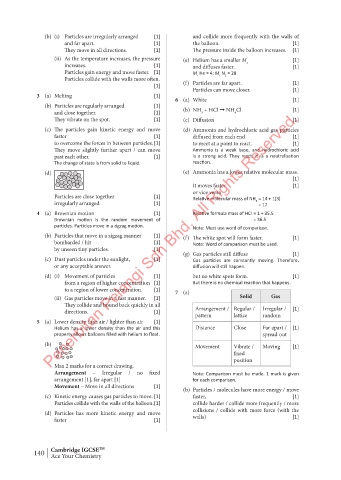
(b)  (i)  Particles are irregularly arranged   [1]         and collide more frequently with the walls of
                             and far apart.                  [1]          the balloon.                       [1]
                             They move in all directions.    [1]          The pressure inside the balloon increases.  [1]
                         (ii)  As the temperature increases, the pressure       (e)  Helium has a smaller M    [1]
                             increases.                      [1]          and diffuses faster.   r           [1]
                             Particles gain energy and move faster.  [1]  M  He = 4; M  N  = 28
                             Particles collide with the walls more often.   r       r  2
                                                             [1]       (f)  Particles are far apart.         [1]
                                                                          Particles can move closer.         [1]
                    3  (a)  Melting                          [1]
                                                                     6  (a)  White                           [1]
                      (b)  Particles are regularly arranged   [1]
                        Penerbitan Pelangi Sdn Bhd. All Rights Reserved.
                         and close together.                 [1]       (b)  NH  + HCl ➞ NH Cl                [1]
                                                                                         4
                                                                             3
                         They vibrate on the spot.           [1]       (c)  Diffusion                        [1]
                      (c)  The  particles  gain  kinetic  energy  and  move       (d)  Ammonia and hydrochloric acid gas particles
                         faster                              [1]          diffused from each end             [1]
                         to overcome the forces in between particles. [1]         to meet at a point to react.   [1]
                         They  move  slightly  further  apart  /  can  move   Ammonia  is  a  weak  base,  and  hydrochloric  acid
                         past each other.                    [1]          is  a  strong  acid.  They  react.  It  is  a  neutralisation
                         The change of state is from solid to liquid.     reaction.
                      (d)                                              (e)  Ammonia has a lower relative molecular mass.
                                                                                                             [1]
                                                                          It moves faster.                   [1]
                                                                          or vice versa
                         Particles are close together        [1]          Relative molecular mass of NH  = 14 + 1(3)
                         irregularly arranged                [1]                                3  = 17
                    4  (a)  Brownian motion                  [1]          Relative formula mass of HCl = 1 + 35.5
                         Brownian  motion  is  the  random  movement  of                        = 36.5
                         particles. Particles move in a zigzag motion.    Note: Must use word of comparison.
                      (b)  Particles that move in a zigzag manner   [1]      (f)  The white spot will form faster.   [1]
                         bombarded / hit                     [1]          Note: Word of comparison must be used.
                         by unseen tiny particles.           [1]
                                                                       (g)  Gas particles still diffuse      [1]
                      (c)  Dust particles under the sunlight,   [1]       Gas  particles  are  constantly  moving.  Therefore,
                         or any acceptable answer.                        diffusion will still happen.
                      (d)  (i)  Movement of particles        [1]          but no white spots form.           [1]
                             from a region of higher concentration  [1]   But there is no chemical reaction that happens.
                             to a region of lower concentration.   [1]    7  (a)
                         (ii)  Gas particles move in a fast manner.   [1]                  Solid      Gas
                             They collide and bound back quickly in all
                             directions.                     [1]           Arrangement /  Regular /   Irregular /  [1]
                                                                           pattern       lattice   random
                    5  (a)  Lower density than air / lighter than air   [1]
                         Helium  has  a  lower  density  than  the  air  and  this   Distance  Close  Far apart /  [1]
                         property allows balloons filled with helium to float.                     spread out
                      (b)                                                  Movement      Vibrate /    Moving  [1]
                                                                                         fixed
                                                                                         position
                         Max 2 marks for a correct drawing.
                         Arrangement  –  Irregular  /  no  fixed          Note: Comparison must be made. 1 mark is given
                         arrangement [1], far apart [1]                   for each comparison.
                         Movement – Move in all directions   [1]
                                                                       (b)  Particles / molecules have more energy / move
                      (c)  Kinetic energy causes gas particles to move. [1]  faster,                         [1]
                         Particles collide with the walls of the balloon. [1]         collide harder / collide more frequently / more
                      (d)  Particles  has  more  kinetic  energy  and  move   collisions  /  collide  with  more  force  (with  the
                         faster                              [1]          walls)                             [1]


                        Cambridge IGCSE  TM
                  140     Ace Your Chemistry


         Answers.indd   140                                                                                         3/4/22   3:54 PM

