


Page 32 - ACE YR IGCSE A TOP APPROACH TO CHEM
P. 32
(b)  Period number can be shown by the number of        Even though uranium is a metal, it is a poor
                         shells.                             [1]              conductor of electricity.
                          The electron distributions of all elements show                (ii) Basic / dissolve in acid / reacts with acid [1]
                         that there are three shells.        [1]              Uranium is a metal. Metal oxide is basic.
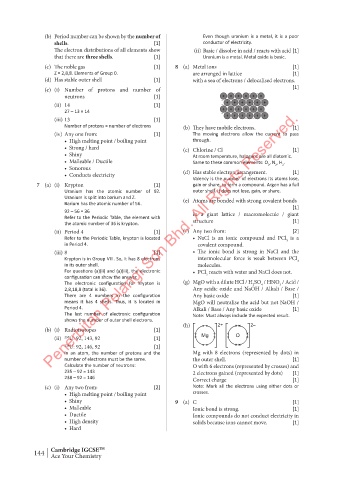
                      (c)  The noble gas                     [1]     8  (a)  Metal ions                      [1]
                         Z = 2,8,8. Elements of Group 0.                  are arranged in lattice            [1]
                      (d)  Has stable outer shell            [1]          with a sea of electrons / delocalised electrons.
                      (e)  (i)  Number of protons and number of                                              [1]
                             neutrons                        [1]                     +  –  +  – –  +  –  +  –  +  –  +
                                                                                    –  +  +  –  +  –  +  –  +  –  +
                         (ii)  14                            [1]                    –  –  –  –  –  –  –  –
                        Penerbitan Pelangi Sdn Bhd. All Rights Reserved.
                             27 – 13 = 14                                           – +  –  +  –  + –  + –  –  +  –  + –  –
                         (iii) 13                            [1]                      +  –  +  +  –  +  –  +  +
                             Number of protons = number of electrons      (b)  They have mobile electrons.   [1]
                         (iv)  Any one from:                 [1]          The  moving  electrons  allow  the  current  to  pass
                             •  High melting point / boiling point        through.
                             •  Strong / hard                          (c)  Chlorine / Cl                    [1]
                             •  Shiny                                     At room temperature, halogens are all diatomic.
                             •  Malleable / Ductile                       Same to these common elements: O , N , H .
                             •  Sonorous                                                             2  2  2
                             •  Conducts electricity                   (d)  Has stable electron arrangement.   [1]
                                                                          Valency is the number of electrons its atoms lose,
                    7  (a)  (i)  Krypton                     [1]          gain or share, to form a compound. Argon has a full
                             Uranium  has  the  atomic  number  of  92.   outer shell. It does not lose, gain, or share.
                             Uranium is split into barium and Z.
                             Barium has the atomic number of 56.       (e)  Atoms are bonded with strong covalent bonds
                             92 – 56 = 36                                                                    [1]
                             Refer to the Periodic Table, the element with          in  a  giant  lattice  /  macromolecule  /  giant
                             the atomic number of 36 is krypton.          structure                          [1]
                         (ii)  Period 4                      [1]       (f)  Any two from:                    [2]
                             Refer to the Periodic Table, krypton is located          •   NaCl  is  an  ionic  compound  and  PCl  is a
                                                                                                           3
                             in Period 4.                                   covalent compound.
                         (iii) 8                             [1]          •   The  ionic  bond  is  strong  in  NaCl  and  the
                             Krypton is in Group VIII. So, it has 8 electrons   intermolecular  force  is  weak  between  PCl 3
                             in its outer shell.                            molecules.
                             For questions (a)(ii) and (a)(iii), the electronic          •   PCl  reacts with water and NaCl does not.
                             configuration can show the answer.                3
                             The  electronic  configuration  for  krypton  is       (g)  MgO with a dilute HCl / H SO  / HNO  / Acid /
                                                                                                         3
                                                                                               2
                                                                                                  4
                             2,8,18,8 (total is 36).                      Any acidic oxide and NaOH / Alkali / Base /
                             There  are  4  numbers  in  the  configuration   Any basic oxide                [1]
                             means  it  has  4  shells.  Thus,  it  is  located  in          MgO will neutralise the acid but not NaOH /
                             Period 4.                                    Alkali / Base / Any basic oxide    [1]
                             The  last  number  of  electronic  configuration   Note: Must always include the expected result.
                             shows the number of outer shell electrons.
                                                                       (h)         2+          2–
                      (b)  (i)  Radioisotopes                [1]
                         (ii)  235 U: 92, 143, 92            [1]             Mg          O
                             238 U: 92, 146, 92              [1]
                             In  an  atom,  the  number  of  protons  and  the          Mg with 8 electrons (represented by dots) in
                             number of electrons must be the same.        the outer shell.                   [1]
                             Calculate the number of neutrons:            O with 6 electrons (represented by crosses) and
                             235 – 92 = 143                               2 electrons gained (represented by dots)   [1]
                             238 – 92 = 146                               Correct charge                     [1]
                      (c)  (i)  Any two from:                [2]          Note:  Mark  all  the  electrons  using  either  dots  or
                             •  High melting point / boiling point        crosses.
                             •  Shiny                                9  (a)  C                               [1]
                             •  Malleable                                 Ionic bond is strong.              [1]
                             •  Ductile                                   Ionic compounds do not conduct electricity in
                             •  High density                              solids because ions cannot move.   [1]
                             •  Hard


                        Cambridge IGCSE  TM
                  144     Ace Your Chemistry


         Answers.indd   144                                                                                         3/4/22   3:54 PM

