


Page 25 - Ranger SPM 2022 Biology
P. 25
Biology SPM  Chapter 2 Leaf Structure and Function
               Mechanism  of Photosynthesis
                 1.  There are two main stages in photosynthesis, namely light-dependent reactions,
                    and light-independent reactions (Figure 2.9).
                 2.  Light-dependent reactions:
             Penerbitan Pelangi Sdn Bhd. All Rights Reserved.
                     •  The light-dependent reactions occur in thylakoid.
                     •  During the light-dependent reactions, photosynthetic pigments on the surface
                      of thylakoid absorb light energy.
                     •  Light energy is used to excite electrons in the chlorophyll pigments to a higher
                      level.
                     •  The excited electrons from the chlorophyll will pass a series of electron carriers.
                      Energy produced from the electrons are used to generate energy in the form of
                      ATP.
                     •  These  electrons  will  finally  be  accepted  by  the  final  electron  carrier,  namely
                      NADP .
                           +
                     •  Simultaneously, light energy will also be used to breakdown water molecule to
                      hydrogen ion (H ) and hydroxyl ion (OH ) by photolysis of water.
                                     +
                                                          -
                     •  NADP  combines with hydrogen ion to from NADPH. Hydroxyl ion loses an electron
                           +
                      to form oxygen and water.
         Form 5
                     •  The products of light-dependent reactions are ATP, NADPH, and oxygen. ATP
                      and NADPH then enters light-independent reactions, whereas oxygen is released
                      to the atmosphere.
                 3.  Light-independent reactions:
                     •  The light-independent reactions occur in stroma.
                     •  During  the light-independent reactions, carbon dioxide binds to the 5-carbon
                      organic compound to form a 6-carbon organic compound.
                     •  NADPH  and ATP produced from the light-dependent reactions reduce the
                      6-carbon organic compound to a glucose monomer.
                     •  Glucose monomer is then condensed to form starch  molecule which is kept in
                      stroma as granules.
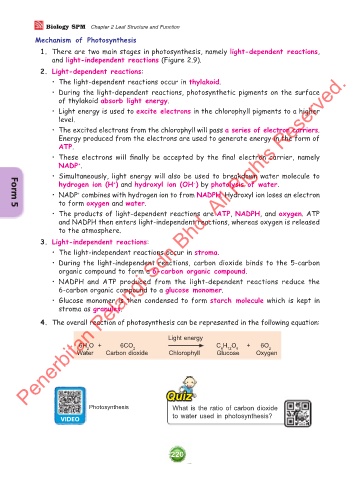
                 4.  The overall reaction of photosynthesis can be represented in the following equation:

                                                                       Light energy
                            6H O  +         6CO                         C H O     +     6O
                                          2
                                                                  6
                                                                    12
                                                                               2
                             2
                                                                      6
                           Water      Carbon dioxide          Chlorophyll        Glucose        Oxygen
                                                   Quiz

                              Photosynthesis         What is the ratio of carbon dioxide
                                                     to water used in photosynthesis?
                      VIDEO


                                                    220


         F5 Chapter 2.indd   220                                                              3/29/22   4:35 PM

